"Who hath ears to hear, let him hear."

Category: Devotion (Page 1 of 3)

When God Notices Your Sweat: The Power of Fiery Zeal

“After him Baruch the son of Zabbai earnestly repaired the other piece, from the turning of the wall unto the door of the house of Eliashib the high priest.” (Nehemiah 3:20, KJV)

Nehemiah chapter three reads like a massive master roster, listing name after name of families, priests, and workers carrying stone along the damaged perimeter of Jerusalem. Most entries follow a simple rhythm: so-and-so repaired this section, and next to him, so-and-so repaired another. But when Nehemiah’s pen reaches Baruch, something shifts. A single word breaks the monotony: earnestly.

Out of dozens of diligent workers, Baruch was singled out for the fierce passion and burning zeal he brought to his assigned post. His name, derived from the Hebrew word for “blessed,” fit his impact perfectly. He didn’t just carry rocks; he worked with an intensity that made people turn their heads.


The Power of Contagious Enthusiasm

Passion is infectious. When someone approaches a tough job with wholehearted energy, it naturally raises the bar for everyone standing nearby. It isn’t hard to picture the chatter along the scaffolding: “Did you see Baruch over there? He laid two hundred bricks before lunch!” “Two hundred? Watch me set four-fifty before the sun goes down.”

Diligence sparks momentum. On the other hand, apathy spreads just as fast. When we treat our daily obligations as mundane drudgery, dragging our feet and barely scraping by with the absolute minimum, we drain the energy out of the room. The Apostle Paul gave the early church a clear remedy for sluggishness: “And whatsoever ye do, do it heartily, as to the Lord, and not unto men” (Colossians 3:23). When you realize your ultimate Supervisor is our heavenly Father, minimum effort is no longer an option.


Character Built in the Mundane

Our walk with Christ frequently leads us into assignments that feel ordinary or unglamorous. We naturally prefer the high-profile roles, building the perfectly straight wall where the whole town can applaud our craftsmanship. Yet, a wall will quickly collapse if no one bothers to mix the mortar with care.

Real Christian character is rarely forged on a public stage where everyone is watching. Public spotlight can easily feed human pride, leading straight to a fall. Instead, God builds deep spiritual stamina in the dull, tedious tasks that go unnoticed by the crowd. Perhaps your daily labor is seen by only one co-worker, one child, or one neighbor. Rest assured, that person is watching your attitude closely to see if your faith makes a real difference in the grind of everyday life.


Becoming a Spark Where You Stand

If you feel stuck in an ordinary, unexciting season, wondering why God hasn’t handed you bigger opportunities, take heart. He hasn’t forgotten you. He might be testing your faithfulness in small things, shaping your humility, or preparing you for something greater down the road.

Or maybe—just maybe—He placed you in that exact spot to be another Baruch. He may have positioned you right there to bring a spark of fiery zeal into a dull environment, lifting up the weary hands of the person working right beside you.

Seed for Thought: Are you approaching your daily responsibilities as a tedious chore or as an act of worship to God? Ask the Lord today to replace any spirit of drudgery with a fresh spark of zeal, using your attitude to encourage someone around you.


Reflect and Respond

  • Evaluating Your Spark: Is your work ethic currently inspiring the people around you, or is a sluggish attitude dragging down your colleagues? Reflect on how approaching your duties “as unto the Lord” changes your daily perspective.

  • Embracing Quiet Assignments: Character is forged in the tedious tasks nobody sees. Are you willing to faithfully mix the mortar and carry out the inconspicuous work without needing constant public recognition?
  • Encouraging the Weary: Who has God placed beside you today who needs to be lifted up by your positive example and earnest effort? Commit to bringing enthusiasm and diligence to your post right where you are.

Share this post

Servant Leadership

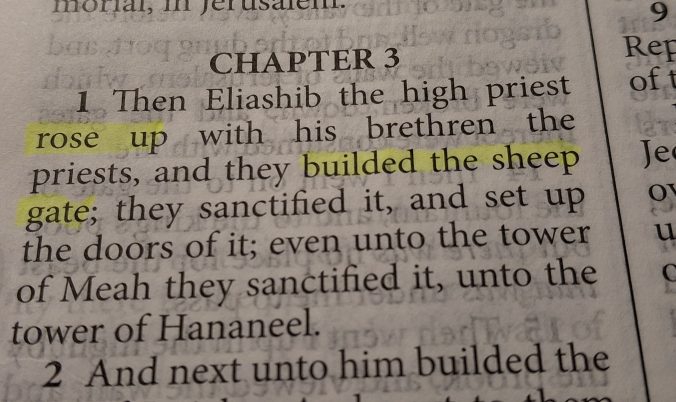
“Then Eliashib the high priest rose up with his brethren the priests, and they builded the sheep gate; they sanctified it, and set up the doors of it; even unto the tower of Meah they sanctified it, unto the tower of Hananeel.” (Nehemiah 3:1, KJV)

True leadership is rarely proven from an elevated platform. It shows up in the dust and sweat of everyday effort. When a project feels overwhelming or a community is hurting, people do not need another motivational speech; they need to see leaders who are willing to get their hands dirty.

When the call went out to rebuild the ruined walls of Jerusalem, Eliashib the high priest did not stand on ceremony. He did not assign the heavy lifting to assistants while reserving a supervisory position for himself. Instead, he stepped up to the rubble alongside his fellow priests and got straight to work.


Leading by Example

Eliashib’s name comes from the Hebrew elyâshı̂yb, meaning “God will restore”. He lived up to that name by aligning his life with God’s restorative purpose. As high priest, Eliashib held the highest religious office in the land, yet he chose to honor God by yielding his authority to serve the people of Jerusalem.

Along with his fellow priests, Eliashib set the pace for the entire nation by being the first to set his hands to the grueling labor of rebuilding. They didn’t wait for others to create momentum. By taking personal initiative, they demonstrated that spiritual leadership is not about title or prestige; it is defined by humble service.


The Shadow and the Substance

Under the Law, God ordained the high priest as the mediator between God and man, calling him to offer animal sacrifices as symbols of obedience and trust for the forgiveness of sins. Those imperfect, temporary sacrifices could only serve as symbolic placeholders. They pointed forward to a deeper reality that was yet to come.

When Jesus Christ arrived as our ultimate High Priest, He completely transformed our understanding of leadership and sacrifice. He didn’t offer animal blood that could never fully wash away sin. Instead, He offered His own sinless blood as the final, complete payment for our redemption. While walking among us as a man, Jesus modeled perfect servant leadership, demonstrating that true greatness is found in laying down one’s life for others.


Entering Through the Sheep Gate

It is worth noting the very first repair project Eliashib and the priests undertook: the Sheep Gate. This was the specific entrance through which sheep and other animals were brought into the city for temple sacrifices. Before any other section of the wall was touched, the gateway dedicated to sacrifice had to be established and sanctified.

In our own lives, spiritual restoration follows that exact same pattern. Before our personal brokenness can be healed, we must first pass through the sacrificial blood of the Lamb of God. The earthly priests were called to build a physical gateway for sacrifice and repentance in Jerusalem. Jesus, our heavenly High Priest, built the eternal gateway for our salvation through His own precious blood.

Seed for Thought: Are you waiting for someone else to fix a broken situation in your church, family, or community? Take a moment today to ask the Lord for a servant’s heart, and be willing to be the first one to step up and help rebuild.


Reflect and Respond

  • Leading from the Front: Eliashib didn’t just instruct others; he was the first one carrying stones and setting up doors. How can you model servant leadership in your own circle of influence this week?

  • The Perfect Sacrifice: Reflect on the contrast between symbolic animal offerings and the untainted blood Jesus offered on your behalf. How does His sacrifice shape your understanding of grace?
  • Starting at the Cross: Just as rebuilding began at the Sheep Gate, personal renewal begins with repentance. Have you brought your brokenness through the gateway of Christ’s salvation, or are you trying to repair your life in your own strength?

Share this post

Bold Confidence

“Then answered I them, and said unto them, The God of heaven, he will prosper us; therefore we his servants will arise and build: but ye have no portion, nor right, nor memorial, in Jerusalem.” (Nehemiah 2:20, KJV)

The moment you set your heart to follow God’s calling, you can almost guarantee that pushback will follow close behind. It never fails. Nehemiah had barely gathered the people and picked up the first tools before critics began mocking their efforts, trying to undermine their resolve.

Yet, notice how Nehemiah handled the jeers. He didn’t engage in endless debates, nor did he boast about his own personal strength or administrative skills. Instead, he humbly acknowledged his true place in God’s plan. He recognized that God Himself was accomplishing the purpose, while he and the people were simply servants stepping into their assigned roles.

Facing the Voice of Discouragement

Whenever we are centered directly in God’s will, there will always be those who attempt to discourage us. Critics will question your motives, point out your limitations, and predict your eventual failure. Expecting difficulties, resistance, and external hindrances is a natural part of committing ourselves to surrender to God’s plan for our lives.

When opposition rears its head, our instinct might be to defend ourselves or prove our doubters wrong. But Nehemiah shows us a far better way. He drew a sharp line in the sand, reminding the opponents that they had no portion, right, or memorial in God’s holy work. We don’t need to win the approval of critics when we are anchored in the promises of the Almighty.

What True Faith Looks Like

So what is faith when the pressure mounts? It isn’t mere optimism, nor is it just a feel-good emotion. Faith is a bold confidence that God Himself will accomplish what He has called us to do.

Too often, we rely on intellectual agreement with truth. Yet even the most passionate belief in principles, doctrines, and precepts cannot steady a person anywhere near as deeply as totally surrendering in unwavering trust to God. Head knowledge and rigid rules will crumble under intense pressure, but a surrendered heart stands firm because its anchor is in the Creator, not in human ideas.

Power Revealed in Humility

When we walk in genuine humility, our faith exposes our own limitations and reveals the infinite power of Almighty God. We aren’t the ones driving the ultimate success of the mission; He is.

As you face whatever trial or task lies before you today, hold fast to Nehemiah’s declaration. We may be simple servants, but by faith we know that “The God of heaven, he will prosper us”. He will grant the strength, supply the resources, and finish the work He started in your life.

Seed for Thought: Are you currently facing discouragement or resistance as you try to follow God’s path? Take a moment right now to move past your own defense strategies, surrender the situation in total trust, and declare that the God of heaven will prosper His work in you.


Reflect and Respond

  • Knowing Your Place as a Servant: Do you view yourself as the primary driver of your spiritual success, or do you humbly acknowledge that God is accomplishing His purpose through you as His servant? Reflect on how shifting your focus to His sovereignty removes the burden of self-reliance.

  • Surrender vs. Intellectual Belief: Is your faith anchored in a simple, total surrender to God, or are you relying strictly on an agreement with principles and doctrines to get you through hard times? Consider how unwavering trust in God provides stability when doctrines alone feel abstract.
  • Standing Firm in the Face of Resistance: When difficulties and opposition arise as you pursue God’s plan, how do you respond? Commit today to resting in the bold confidence that the God of heaven will prosper you as you arise and build.

Share this post

Surveying the Rubble

“And I arose in the night, I and some few men with me; neither told I any man what my God had put in my heart to do at Jerusalem: neither was there any beast with me, save the beast that I rode upon.” (Nehemiah 2:12, KJV)

Under the quiet cover of darkness, while the rest of the city slept, Nehemiah slipped out through the Valley Gate. He didn’t make a grand public announcement or parade his plans in front of the crowds. Instead, accompanied by only a few trusted companions, he rode out under the moonlight to conduct a quiet, secret inspection.

As he surveyed the broken walls alone in the stillness of night, God walked beside him, granting him the sharp discernment needed to accurately evaluate the destruction. Nehemiah needed a clear, unfiltered understanding of the exact conditions of the ruined walls he was called to rebuild. Before we attempt to repair any brokenness, whether in our own hearts, our relationships, or circumstances around us; we must follow Nehemiah’s lead and survey the rubble with open eyes and discerning hearts.

Taking an Honest Inventory

To rebuild effectively, we have to take a careful inventory and check the integrity of the original foundation. With God’s help, we need spiritual clarity to see if there is any lasting value left in the rubble or if there are repairable cracks in the structure. In some cases, we might discover that a minor patch-up job simply won’t cut it; we need God’s spiritual bulldozer to sweep away the debris entirely so we can start fresh on the sure, unshakable foundation of Jesus Christ.

Counting the Cost and Studying the Blueprint

Riding among the ruins also gave Nehemiah the chance to start tallying up the exact materials required to rebuild the city walls. Jesus echoed this principle in Luke 14:28 when He asked, “For which of you, intending to build a tower, sitteth not down first, and counteth the cost, whether he have sufficient to finish it?”

The exact same precept applies to anyone desiring to build a life of godly integrity and Christian character. If we want to grow more like Christ, the very first step is ensuring that Jesus’ precious blood has been applied to our sinful souls. Beyond that initial step of salvation, we must dedicate daily effort to understanding God’s plan for our lives.

Worn Plans and Heavenly Provisions

Much like a modern architect drafting detailed blueprints, Nehemiah likely sketched out drawings of the construction work that needed to be carried out. Construction workers must constantly refer back to the master drawings throughout the building process to ensure everything aligns with the architect’s design. By the time the building is finished, those paper plans are usually marked up, smudged, and well-worn from daily use.

In the same way, as we navigate our daily walk with God, our Bibles ought to be well-worn from constant reading, and our knees calloused by earnest prayer. That is how we ensure we are building according to God’s blueprint, laying up eternal treasures for when we reach heaven’s gate.

Just as king Artaxerxes provided the physical materials Nehemiah needed to rebuild Jerusalem’s walls, our King Jesus provides every spiritual resource we need to construct a vibrant Christian life. In return, He asks for our full surrender; that we take up our cross daily and follow Him.

Seed for Thought: Is there an area in your life where you have been trying to build on a cracked foundation or guessing at the blueprint? Take time today to get alone with God in prayer, open His Word, and ask Him to reveal what needs to be cleared away so you can build on Christ alone.

Reflect and Respond

  • Surveying Your Foundation: Have you taken time recently to quietly survey the state of your own heart or relationships, or are you ignoring the cracks in your spiritual foundation? Ask God to give you open eyes and discerning judgment as you evaluate your spiritual health.
  • Consulting the Blueprint: Is your Bible well-worn from daily consultation, or has it sat gathering dust on a shelf? Consider how constantly referencing God’s Word keeps your life aligned with His master plan.
  • Surrendering to the King: King Jesus has provided everything you need to build a life of godly character, but He asks for total surrender in return. What cross or burden are you being called to pick up today as you follow Him?

Share this post

A Changed Countenance

“And said unto the king, Let the king live for ever: why should not my countenance be sad, when the city, the place of my fathers’ sepulchres, lieth waste, and the gates thereof are consumed with fire?”
(Nehemiah 2:3, KJV)

Have you ever tried hiding a heavy heart? It is almost impossible. No matter how hard we try to put on a brave face, deep sorrow or an overwhelming burden eventually finds a way to leak out.

That is right where Nehemiah found himself. The massive task God laid on his heart—rebuilding the ruined city of Jerusalem—was simply too big for one man to carry alone. It weighed down his spirit so heavily that he couldn’t mask it anymore. His grief showed right on his face. Standing before the king with a sad countenance was risky, but God used Nehemiah’s visible distress as an open door. King Artaxerxes noticed, asked what was wrong, giving Nehemiah the exact opportunity he needed to ask for help.

The Weight of the Mission

If we are honest with ourselves, we have been handed a task that feels just as daunting. In Matthew 28:19-20, Jesus laid out our clear burden: to go and reach all nations with the gospel. When you step back and look at the sheer scale of that calling, it is easy to feel intimidated, fearful, or entirely overwhelmed. Facing friends, neighbors, or a culture that seems disinterested in Christ can leave us feeling utterly helpless.

Never Laboring Alone

Here is the good news: Jesus never asked us to shoulder this burden in our own limited strength. Right after giving that monumental command, He promised to be with us always. We do not have to figure this out by ourselves.

God gave us the book of Ephesians to show us how to stand firm against the enemy’s tactics as we work. On top of that, He gave us a local church family. We have brothers and sisters in Christ to encourage us, sharpen us, and labor right alongside us as we go.

Equipped for the Purpose

Caring about lost souls ought to weigh on us. It should soften our hearts and, yes, even change our countenance at times. Indifference has no place in the life of a believer. But a heavy heart should never drive us to despair. Our great Father in heaven has already provided every spiritual truth, every resource, and every bit of grace we need to accomplish His purpose.

Seed for Thought: Does the burden for reaching lost souls show in your life, or have you grown comfortable and detached? Take a moment right now to ask God for a heart that genuinely cares for the lost, while trusting Him to supply everything you need to reach them.

Reflect and Respond

  • A Heart That Shows: Does your concern for lost people ever show on your face, or do you keep your spiritual burdens hidden away? Reflect on how Nehemiah’s open vulnerability became the very doorway God used to grant him favor.

  • Facing the Monumental Task: When you think about sharing the gospel in a world that often rejects it, do you feel fearful or overwhelmed? Remind yourself of Jesus’ promise in Matthew 28 that He is right beside you every step of the way.
  • Leaning on Your Provision: Are you trying to carry out God’s calling alone, or are you actively drawing strength from His Word and your church family? Take time this week to thank God for the spiritual tools and fellow believers He has placed around you to help you fulfill your purpose.

Share this post

Shaken Faith

“O Lord, I beseech thee, let now thine ear be attentive to the prayer of thy servant, and to the prayer of thy servants, who desire to fear thy name: and prosper, I pray thee, thy servant this day, and grant him mercy in the sight of this man. For I was the king’s cupbearer.” (Nehemiah 1:11, KJV)

To modern ears, the role of a cupbearer might sound like a simple, domestic task, but in the Persian court, it was a position of supreme importance and constant danger. The cupbearer was the king’s most trustworthy confidant. Day after day, he willingly put his own life on the line to safeguard the ruler against treason and poisoning. Succeeding in this role required unrelenting vigilance over every detail of food storage and preparation, along with ensuring that wine and other beverages were properly sourced and free from deadly contaminants.

Yet, the rewards associated with this solemn duty were considerable. Nehemiah enjoyed direct, daily access to the royal presence. His personal integrity placed him in a respected position of influence with the individual holding the highest power in the land. Because of this close relationship, Nehemiah was routinely expected to offer counsel on decisions affecting the king’s best interest. But a deep tension was rising within him. He now needed a royal decision that would favor the interests of his own suffering people and the broken city of Jerusalem.

The Discomfort of God’s Calling

Stepping up to follow God’s direction can often feel awkward and unsettling. When God prompts us to move, our faith can easily be shaken by unexpected doubt and anxiety. We naturally prefer the safety of familiar routines, yet divine obedience almost always asks us to step beyond our comfort zone. For Nehemiah, acting on God’s call meant risking his personal reputation, his security, and his standing with the king.

A Faith Strengthened Through Shaking

When we submit to our heavenly Father in obedience, we must allow Him to shake our faith a bit during the process. This shaking is not meant to break us; rather, God uses it to strengthen our spirit for the exact task He has set before us. By allowing our earthly security to feel uncertain, God teaches us to rely fully on His divine power rather than our own credentials or position.

Trading Doubt for Divine Confidence

Approaching a powerful ruler to ask him to favor a ruined, conquered city was a massive risk. Yet, God routinely replaces our fear and doubt with firm confidence whenever we choose to trust in His plan. Nehemiah didn’t rely on clever politics or personal charm; he brought his petition to the Lord first, asking for mercy before he spoke a single word to the king. When God places you in a position of responsibility, He will grant you the courage and wisdom to fulfill His purpose.

Seed for Thought: Has God placed you in a position of influence or responsibility where stepping up feels risky or uncomfortable? Take a moment right now to submit your fears to the Lord, trusting Him to replace your anxiousness with the confidence needed to follow His plan.

Reflect and Respond

  • Stewarding Your Influence: Nehemiah was the king’s most trustworthy confidant, using his integrity and royal access to advocate for Jerusalem. How can you leverage the position or influence God has granted you to help others and honor Him?
  • Enduring the Uncertainty: Stepping out in obedience can feel awkward, and our faith is often tested by doubt. Are you willing to let God use those moments of uncertainty to strengthen your spirit for the work ahead?
  • Replacing Fear with Trust: Following God’s call required Nehemiah to risk his reputation and his relationship with the king. What fears or doubts are holding you back today, and will you trust God to grant you confidence as you step out in faith?
Share this post

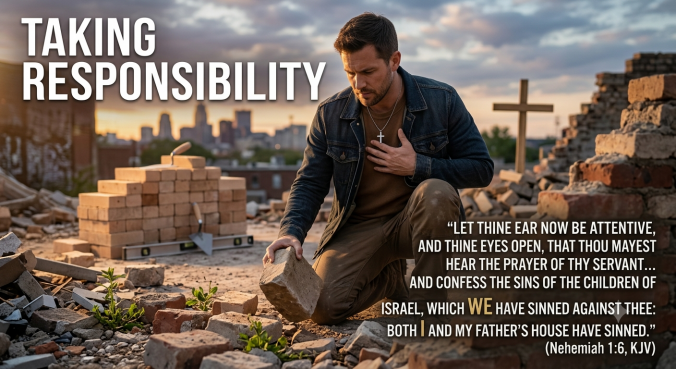
Taking Responsibility

“Let thine ear now be attentive, and thine eyes open, that thou mayest hear the prayer of thy servant, which I pray before thee now, day and night, for the children of Israel thy servants, and confess the sins of the children of Israel, which we have sinned against thee: both I and my father’s house have sinned.” (Nehemiah 1:6, KJV)

Whenever a crisis hits or a difficult situation unfolds, our natural human instinct is to look for someone else to blame. It is always much easier to point out the flaws, mistakes, and shortcomings of the people around us than it is to look honestly into our own hearts. When things begin to fall apart in our families, our churches, or our communities, we frequently look for a convenient scapegoat so we can remove our hands from the problem.

However, Nehemiah modeled a completely different approach to brokenness. When he received the devastating news about the ruined walls and burned gates of Jerusalem, he didn’t launch into a critical evaluation of the failed leaders who had preceded him. Instead, he fell to his knees in deep intercession. As he poured out his heart to the Lord, his prayer featured two incredibly powerful words: we and I. Rather than distancing himself from the problem, he included himself directly, taking personal blame for the brokenness of his homeland.

The Deception of Pointing Fingers

It would have been very easy for Nehemiah to point a finger at the generations of Israelites who had failed their responsibilities before him. After all, he was living hundreds of miles away, serving comfortably in the Persian palace. He had no personal role in the historic failures that led to Jerusalem’s destruction. Yet, he understood a vital truth that every believer must learn: pointing fingers simply does not get any work done. A great leader refuses to stand on the sidelines as a mere critic. Instead, a true leader must lead by example, being the first one to take responsibility and the first one to take up the tools to start building.

The Posture of True Prayer

God has graciously given us the privilege of prayer, allowing us to bring our deepest burdens directly before His throne. But prayer is not a platform for us to complain about the faults of others. We must enter into prayer with genuine humility and a repentant heart. If we approach God while harboring bitterness, or if we are constantly blaming others for our current situation, our prayers will be hindered. If we find ourselves focusing entirely on the failures of those around us, our first petition must be for God to change our own attitude.

Stepping into the Gap

Spiritual restoration can only begin when we stop making excuses and start owning our part in the circumstances around us. Nehemiah’s willingness to confess his own sins, along with the sins of his nation, cleared the way for God to use him in a miraculous way. When we humble ourselves and take responsibility, we invite the Holy Spirit to work through us to bring healing. Do not wait for someone else to take the first step toward reconciliation or rebuilding. Allow God to work on your heart today, and be willing to be the one who steps into the dust to start the restoration process.

Seed for Thought: Is there a broken area in your life, family, or church where you have been pointing fingers at others? Take a moment right now to bring that situation to the Lord in humility, asking Him to shift your focus from others’ failures to what He wants to do through you.

Reflect and Respond

  • Owning the Brokenness: When you pray about the problems in your immediate circle, do you include yourself in the confession, or do you view yourself as an innocent bystander? Reflect on how Nehemiah’s choice to use “we” and “I” opened the door for God’s power to move.
  • Leading by Example: Are you currently waiting for someone else to fix a broken situation, or are you willing to lead by example? Consider what it looks like to be the first one to take responsibility and actively pick up the tools to start building today.
  • Exchanging Blame for Humility: Think about whether you have been blaming others for your current circumstances. If so, are you willing to make your first petition a prayer for God to change your attitude? Commit to entering His presence with a truly humble and repentant heart.

Share this post

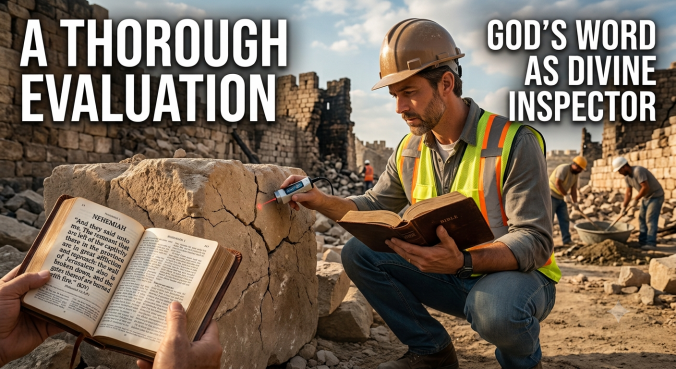
A Thorough Evaluation

“And they said unto me, The remnant that are left of the captivity there in the province are in great affliction and reproach: the wall of Jerusalem also is broken down, and the gates thereof are burned with fire.” (Nehemiah 1:3, KJV)

House flipping has become quite a lucrative enterprise in today’s real estate market. Anyone with a few basic skills and a little management savvy can buy an older or distressed house, make the needed repairs, then resell it at a handsome profit. The key to making this a successful business, though, begins with a thorough evaluation of the prospective house’s condition. Cleaning and painting might make for a quick resale, but if the house isn’t structurally sound, the new homeowner will be extremely disappointed and may take legal action against you. A prudent house flipper will hire a licensed inspector to investigate and report the home’s condition from the ground up.

Nehemiah understood this concept as he accepted his calling to rebuild the city of Jerusalem. When word reached him concerning the ruin of his homeland, he knew that a superficial patch-up wouldn’t suffice. As we study the book of Nehemiah, we can see God’s blueprint for rebuilding the broken walls and burned gates in our own lives.

The Condition: Assessing the Brokenness

While we may not be required to rebuild an ancient city, we are often called to rebuild broken relationships in our lives, broken lives due to some tragedy, or maybe even broken churches. Brokenness has a way of exposing the fragility of our own strength.

The first step in any restoration project is facing the damage honestly. Nehemiah did not minimize the report he received; he allowed the weight of Jerusalem’s condition to drive him to his knees. Before we can begin rebuilding, we must be willing to look directly at the rubble of our circumstances without pretending everything is fine.

The Inspection: Evaluating by the Word

Our first step in rebuilding the brokenness should always include a thorough evaluation in the light of God’s Word. Scripture serves as our divine inspector, revealing the hidden faults, compromised foundations, and structural weaknesses that we might otherwise overlook.

When we hold our broken situations up to the mirror of God’s truth, we are no longer guessing at how to fix them. The Word provides the exact measurements, standards, and wisdom required to construct something lasting. A thorough evaluation allows us to see where we have drifted from God’s design so we can begin the intentional work of structural alignment.

Rebuilding from the Ground Up

True restoration is never an overnight cosmetic job. It requires patience, obedience, and a lifelong commitment to God’s structural process. Do not let discouragement tempt you to settle for a quick, surface-level cover-up of deep-seated issues.

Stand firm in the knowledge that the Lord is the Master Builder. If you will allow Him to inspect your heart and lead the reconstruction, He will take what has been ruined by fire and transform it into a lasting testimony of His faithfulness.

Seed for Thought: What area of your life—whether a relationship, a personal habit, or a spiritual discipline—is currently experiencing brokenness? Take a moment right now to present this area before the Lord, asking Him to begin a thorough evaluation through His Word.

Reflect and Respond

  • Assessing the Condition: When faced with a crisis or a broken relationship, do you tend to rush into quick, cosmetic fixes, or do you take the time for an honest evaluation? Consider how acknowledging the true state of your circumstances is essential for genuine healing.
  • The Divine Standard: How often do you allow God’s Word to serve as the structural inspector of your heart? Reflect on how aligning your personal evaluation with Scripture changes your approach to rebuilding broken areas.
  • A Sound Foundation: Are you trying to rebuild a part of your life using your own management savvy, or are you relying on the ground-up restoration that only the Holy Spirit can provide? Commit today to building a spiritual foundation that will stand strong against the storms of life.
Share this post

Stopping the Spiritual Drift

Therefore we ought to give the more earnest heed to the things which we have heard, lest at any time we should let them slip. For if the word spoken by angels was stedfast, and every transgression and disobedience received a just recompence of reward; How shall we escape, if we neglect so great salvation; which at the first began to be spoken by the Lord, and was confirmed unto us by them that heard him; (Hebrews 2:1-3)

In the rush of our daily routines, it is incredibly easy to find ourselves drifting. Hebrews 2:1 gives us a sobering nudge: we must give “earnest heed” to the truths we’ve heard, lest we let them slip. Think of a vessel with a tiny, unnoticed crack; it doesn’t empty all at once, but drop by drop, the living water escapes until the jar is dry. Our spiritual lives often follow a similar path. We don’t usually decide to abandon our faith in one giant leap; rather, we slowly lose our grip on the Word through simple inattention. When we stop prioritizing our time at the feet of Jesus, the vibrant truths of the Gospel begin to leak out of our hearts, leaving us vulnerable to the currents of the world around us.

This isn’t just a suggestion—it’s a vital safeguard for our souls. The writer of Hebrews asks a piercing question: “How shall we escape, if we neglect so great salvation?” Notice that the warning isn’t directed at those who reject Christ, but those who neglect Him. You don’t have to actively fight against God to lose your way; you only have to do nothing. This salvation was spoken by the Lord Himself and is far too precious to be treated as a background thought or a Sunday-only ritual. Today, let’s choose to tighten our grip on His promises. Let’s stop the drift by anchoring our hearts once again in the “so great” love that rescued us, making sure His Word isn’t just something we’ve heard, but something we are actively holding onto.

A Prayer for an Anchored Heart

Heavenly Father,
I thank You for the “so great salvation” You have poured into my life through Jesus. Forgive me for the times I’ve treated Your grace as a background noise rather than the very air I breathe. Lord, I don’t want to be a drifter. I don’t want to let the precious truths of Your Word slip through the cracks of a busy schedule or a distracted mind. Today, I ask for the grace to give “earnest heed” to Your voice. Anchor my soul in Your promises so that no matter how hard the winds of life blow, I remain tethered to You. Keep my heart soft, my eyes open, and my spirit attentive to Your presence. In Jesus’ name, Amen.

Cultivating the Heart: Reflection Questions

In the spirit of “Seed Sowing,” use these questions to examine the current state of your spiritual garden.

• Identifying the Leak: If you feel “dry” spiritually, look at your daily routine. What are the “cracks” (distractions, habits, or anxieties) that are causing the living water of the Word to leak out of your heart?
• The Difference Between Hearing and Heeding: We often hear a sermon or read a verse and then immediately move on. What is one specific truth from Hebrews 2 that you can move from your head to your hands—acting on it today rather than just thinking about it?
• Defining “Neglect”: Neglect isn’t usually a loud rebellion; it’s a quiet forgetting. Is there a part of your relationship with God—like prayer, fellowship, or study—that has become a “Sunday-only” ritual? How can you move it back to the center of your Monday-through-Saturday life?
• The Weight of the Gift: Spend a few minutes meditating on the phrase “so great salvation.” If you truly viewed your salvation as the most valuable treasure you owned, how would your “earnest heed” change this week?

Share this post

Purpose

But Daniel purposed in his heart that he would not defile himself with the portion of the king’s meat, nor with the wine which he drank: therefore he requested of the prince of the eunuchs that he might not defile himself. (Dan 1:8)

The young Daniel we read about here has been taken into captivity in Babylon. Like Daniel, we are held captive to this world. While we cannot change this circumstance, we can set ourselves apart from our captor. Daniel chose to hold on to his faith in God rather than conform to his ungodly environment. As Christians, we are to follow Daniel’s example by living our life with intention to please God, not men.

God rewarded Daniel for his faith by elevating his status in the eyes of his captors. While he was severely tested at times, he held the favor of the king of Babylon for most of his life. We are not promised the same treatment in our captivity. However, when we purpose in our heart to be faithful Jesus our Savior, we are promised that one day the chains that hold us captive to this world will be broken. The world holds no power over the promises of God. Simply trusting in Jesus assures us according to His word that nothing can pluck us out of His hand.

Today, let’s reaffirm our purpose; follow God; allow Him to transform us to His will rather than conform to this world.

Share this post
« Older posts

© 2026 SeedSowing.org

Theme by Anders Noren — Up ↑