"Who hath ears to hear, let him hear."

Tag: spiritual growth

Shaken Faith

O Lord, I beseech thee, let now thine ear be attentive to the prayer of thy servant, and to the prayer of thy servants, who desire to fear thy name: and prosper, I pray thee, thy servant this day, and grant him mercy in the sight of this man. For I was the king’s cupbearer.” (Nehemiah 1:11, KJV)

To modern ears, the role of a cupbearer might sound like a simple, domestic task, but in the Persian court, it was a position of supreme importance and constant danger. The cupbearer was the king’s most trustworthy confidant. Day after day, he willingly put his own life on the line to safeguard the ruler against treason and poisoning. Succeeding in this role required unrelenting vigilance over every detail of food storage and preparation, along with ensuring that wine and other beverages were properly sourced and free from deadly contaminants.

Yet, the rewards associated with this solemn duty were considerable. Nehemiah enjoyed direct, daily access to the royal presence. His personal integrity placed him in a respected position of influence with the individual holding the highest power in the land. Because of this close relationship, Nehemiah was routinely expected to offer counsel on decisions affecting the king’s best interest. But a deep tension was rising within him. He now needed a royal decision that would favor the interests of his own suffering people and the broken city of Jerusalem.

The Discomfort of God’s Calling

Stepping up to follow God’s direction can often feel awkward and unsettling. When God prompts us to move, our faith can easily be shaken by unexpected doubt and anxiety. We naturally prefer the safety of familiar routines, yet divine obedience almost always asks us to step beyond our comfort zone. For Nehemiah, acting on God’s call meant risking his personal reputation, his security, and his standing with the king.

A Faith Strengthened Through Shaking

When we submit to our heavenly Father in obedience, we must allow Him to shake our faith a bit during the process. This shaking is not meant to break us; rather, God uses it to strengthen our spirit for the exact task He has set before us. By allowing our earthly security to feel uncertain, God teaches us to rely fully on His divine power rather than our own credentials or position.

Trading Doubt for Divine Confidence

Approaching a powerful ruler to ask him to favor a ruined, conquered city was a massive risk. Yet, God routinely replaces our fear and doubt with firm confidence whenever we choose to trust in His plan. Nehemiah didn’t rely on clever politics or personal charm; he brought his petition to the Lord first, asking for mercy before he spoke a single word to the king. When God places you in a position of responsibility, He will grant you the courage and wisdom to fulfill His purpose.

Seed for Thought: Has God placed you in a position of influence or responsibility where stepping up feels risky or uncomfortable? Take a moment right now to submit your fears to the Lord, trusting Him to replace your anxiousness with the confidence needed to follow His plan.

Reflect and Respond

  • Stewarding Your Influence: Nehemiah was the king’s most trustworthy confidant, using his integrity and royal access to advocate for Jerusalem. How can you leverage the position or influence God has granted you to help others and honor Him?
  • Enduring the Uncertainty: Stepping out in obedience can feel awkward, and our faith is often tested by doubt. Are you willing to let God use those moments of uncertainty to strengthen your spirit for the work ahead?
  • Replacing Fear with Trust: Following God’s call required Nehemiah to risk his reputation and his relationship with the king. What fears or doubts are holding you back today, and will you trust God to grant you confidence as you step out in faith?
Share this post

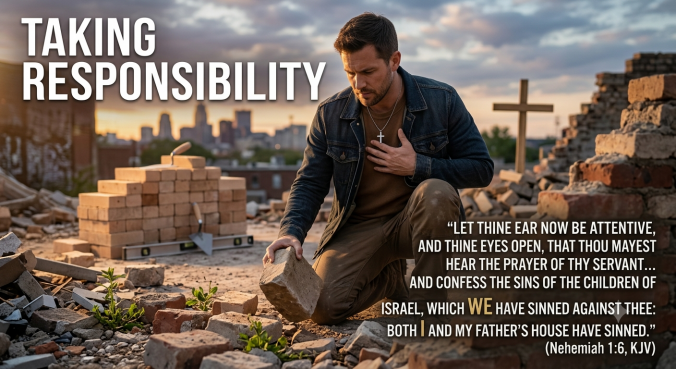
Taking Responsibility

Let thine ear now be attentive, and thine eyes open, that thou mayest hear the prayer of thy servant, which I pray before thee now, day and night, for the children of Israel thy servants, and confess the sins of the children of Israel, which we have sinned against thee: both I and my father’s house have sinned.” (Nehemiah 1:6, KJV)

Whenever a crisis hits or a difficult situation unfolds, our natural human instinct is to look for someone else to blame. It is always much easier to point out the flaws, mistakes, and shortcomings of the people around us than it is to look honestly into our own hearts. When things begin to fall apart in our families, our churches, or our communities, we frequently look for a convenient scapegoat so we can remove our hands from the problem.

However, Nehemiah modeled a completely different approach to brokenness. When he received the devastating news about the ruined walls and burned gates of Jerusalem, he didn’t launch into a critical evaluation of the failed leaders who had preceded him. Instead, he fell to his knees in deep intercession. As he poured out his heart to the Lord, his prayer featured two incredibly powerful words: we and I. Rather than distancing himself from the problem, he included himself directly, taking personal blame for the brokenness of his homeland.

The Deception of Pointing Fingers

It would have been very easy for Nehemiah to point a finger at the generations of Israelites who had failed their responsibilities before him. After all, he was living hundreds of miles away, serving comfortably in the Persian palace. He had no personal role in the historic failures that led to Jerusalem’s destruction. Yet, he understood a vital truth that every believer must learn: pointing fingers simply does not get any work done. A great leader refuses to stand on the sidelines as a mere critic. Instead, a true leader must lead by example, being the first one to take responsibility and the first one to take up the tools to start building.

The Posture of True Prayer

God has graciously given us the privilege of prayer, allowing us to bring our deepest burdens directly before His throne. But prayer is not a platform for us to complain about the faults of others. We must enter into prayer with genuine humility and a repentant heart. If we approach God while harboring bitterness, or if we are constantly blaming others for our current situation, our prayers will be hindered. If we find ourselves focusing entirely on the failures of those around us, our first petition must be for God to change our own attitude.

Stepping into the Gap

Spiritual restoration can only begin when we stop making excuses and start owning our part in the circumstances around us. Nehemiah’s willingness to confess his own sins, along with the sins of his nation, cleared the way for God to use him in a miraculous way. When we humble ourselves and take responsibility, we invite the Holy Spirit to work through us to bring healing. Do not wait for someone else to take the first step toward reconciliation or rebuilding. Allow God to work on your heart today, and be willing to be the one who steps into the dust to start the restoration process.

Seed for Thought: Is there a broken area in your life, family, or church where you have been pointing fingers at others? Take a moment right now to bring that situation to the Lord in humility, asking Him to shift your focus from others’ failures to what He wants to do through you.

Reflect and Respond

  • Owning the Brokenness: When you pray about the problems in your immediate circle, do you include yourself in the confession, or do you view yourself as an innocent bystander? Reflect on how Nehemiah’s choice to use “we” and “I” opened the door for God’s power to move.
  • Leading by Example: Are you currently waiting for someone else to fix a broken situation, or are you willing to lead by example? Consider what it looks like to be the first one to take responsibility and actively pick up the tools to start building today.
  • Exchanging Blame for Humility: Think about whether you have been blaming others for your current circumstances. If so, are you willing to make your first petition a prayer for God to change your attitude? Commit to entering His presence with a truly humble and repentant heart.

Share this post

Empathy or Compassion?

And it came to pass, when I heard these words, that I sat down and wept, and mourned certain days, and fasted, and prayed before the God of heaven,” (Nehemiah 1:4, KJV)

The mission project placed before Nehemiah was clearly obvious: he was called to rebuild the ruined city of Jerusalem. Yet, when we consider his life up to this point, the magnitude of this calling becomes even more striking. Nehemiah was part of the third generation of Hebrews living in captivity, meaning he was likely born in Persia and had never once set foot in the ancestral homeland of his forefathers.

Furthermore, the people currently living in Jerusalem were not his immediate relatives or near kinsmen. While it was entirely natural for him to feel a sense of empathy for these distant people in their affliction and reproach, human empathy alone would never provide the sustained passion required to successfully complete the monumental task God had set before him.

The Limitation of Human Empathy

True empathy is a basic human emotion that stems from a genuine love and caring for our fellow man. When we see a person in distress, a broken home, a fractured community, or a struggling church, our natural response is to feel their pain. However, empathy on its own has its limits. It allows us to feel sorrow for a situation, but it often lacks the enduring strength needed to bring about lasting restoration. For Nehemiah, a simple emotional reaction to the news of Jerusalem’s broken walls wasn’t enough; his natural empathy needed to be transformed into something far deeper.

The Catalyst of Divine Passion

Instead of letting his emotions fizzle out, Nehemiah allowed his empathy to drive him straight to his knees. He sat down and wept, mourned for days, fasted, and prayed as he passionately pleaded with God to find clear direction for rebuilding what had been broken. It was in this season of intercession that a powerful shift occurred: God replaced Nehemiah’s basic empathy with a divine passion. While empathy is a natural human emotion, true passion is instilled directly by our heavenly Father. It acts as a spiritual catalyst, energizing us to keep moving forward until the mission is fully complete.

Facing the Brokenness Around Us

As Christians, we will inevitably face many broken things throughout our journey in life. This brokenness may manifest deep within ourselves, or it may be evident in the lives of our nearby loved ones. At times, we will see it plaguing our local communities, or even affecting peoples and nations far across the globe. In every broken situation put before us, we cannot rely on superficial emotions. We must follow Nehemiah’s example and be willing to weep, fast, and pray for direction by the Holy Spirit.

When we surrender our natural feelings to the Lord, He promises to plant the very passion in our hearts that we need to accomplish His divine will.

Seed for Thought: What broken situation or hurting person has God placed in your path today? Take a moment right now to move past simple empathy, and ask the Lord to ignite a divine passion in your heart to fulfill your part in His plan for healing.

Reflect and Respond

  • Moving Beyond Empathy: When you encounter someone in distress or a broken situation, do you rely solely on natural empathy, or does that feeling drive you to your knees in prayer? Consider how Nehemiah’s initial sorrow served as a doorway to pleading with God for true direction.

  • The Fuel of Divine Passion: Reflect on the difference between a basic human emotion and a supernatural passion instilled by the Father. Are you currently trying to address a broken home, community, or church out of your own limited strength, or are you relying on the catalyst that energizes you to finish the task?
  • Seeking Holy Spirit Direction: Are you fully willing to weep, fast, and pray over the broken areas within yourself, your loved ones, or nations far away? Commit today to actively seeking the Holy Spirit’s guidance, trusting that God will plant the exact passion required to accomplish His divine will.

Share this post

Stopping the Spiritual Drift

Therefore we ought to give the more earnest heed to the things which we have heard, lest at any time we should let them slip. For if the word spoken by angels was stedfast, and every transgression and disobedience received a just recompence of reward; How shall we escape, if we neglect so great salvation; which at the first began to be spoken by the Lord, and was confirmed unto us by them that heard him; (Hebrews 2:1-3)

In the rush of our daily routines, it is incredibly easy to find ourselves drifting. Hebrews 2:1 gives us a sobering nudge: we must give “earnest heed” to the truths we’ve heard, lest we let them slip. Think of a vessel with a tiny, unnoticed crack; it doesn’t empty all at once, but drop by drop, the living water escapes until the jar is dry. Our spiritual lives often follow a similar path. We don’t usually decide to abandon our faith in one giant leap; rather, we slowly lose our grip on the Word through simple inattention. When we stop prioritizing our time at the feet of Jesus, the vibrant truths of the Gospel begin to leak out of our hearts, leaving us vulnerable to the currents of the world around us.

This isn’t just a suggestion—it’s a vital safeguard for our souls. The writer of Hebrews asks a piercing question: “How shall we escape, if we neglect so great salvation?” Notice that the warning isn’t directed at those who reject Christ, but those who neglect Him. You don’t have to actively fight against God to lose your way; you only have to do nothing. This salvation was spoken by the Lord Himself and is far too precious to be treated as a background thought or a Sunday-only ritual. Today, let’s choose to tighten our grip on His promises. Let’s stop the drift by anchoring our hearts once again in the “so great” love that rescued us, making sure His Word isn’t just something we’ve heard, but something we are actively holding onto.

A Prayer for an Anchored Heart

Heavenly Father,
I thank You for the “so great salvation” You have poured into my life through Jesus. Forgive me for the times I’ve treated Your grace as a background noise rather than the very air I breathe. Lord, I don’t want to be a drifter. I don’t want to let the precious truths of Your Word slip through the cracks of a busy schedule or a distracted mind. Today, I ask for the grace to give “earnest heed” to Your voice. Anchor my soul in Your promises so that no matter how hard the winds of life blow, I remain tethered to You. Keep my heart soft, my eyes open, and my spirit attentive to Your presence. In Jesus’ name, Amen.

Cultivating the Heart: Reflection Questions

In the spirit of “Seed Sowing,” use these questions to examine the current state of your spiritual garden.

• Identifying the Leak: If you feel “dry” spiritually, look at your daily routine. What are the “cracks” (distractions, habits, or anxieties) that are causing the living water of the Word to leak out of your heart?
• The Difference Between Hearing and Heeding: We often hear a sermon or read a verse and then immediately move on. What is one specific truth from Hebrews 2 that you can move from your head to your hands—acting on it today rather than just thinking about it?
• Defining “Neglect”: Neglect isn’t usually a loud rebellion; it’s a quiet forgetting. Is there a part of your relationship with God—like prayer, fellowship, or study—that has become a “Sunday-only” ritual? How can you move it back to the center of your Monday-through-Saturday life?
• The Weight of the Gift: Spend a few minutes meditating on the phrase “so great salvation.” If you truly viewed your salvation as the most valuable treasure you owned, how would your “earnest heed” change this week?

Share this post

Purpose

But Daniel purposed in his heart that he would not defile himself with the portion of the king’s meat, nor with the wine which he drank: therefore he requested of the prince of the eunuchs that he might not defile himself. (Dan 1:8)

The young Daniel we read about here has been taken into captivity in Babylon. Like Daniel, we are held captive to this world. While we cannot change this circumstance, we can set ourselves apart from our captor. Daniel chose to hold on to his faith in God rather than conform to his ungodly environment. As Christians, we are to follow Daniel’s example by living our life with intention to please God, not men.

God rewarded Daniel for his faith by elevating his status in the eyes of his captors. While he was severely tested at times, he held the favor of the king of Babylon for most of his life. We are not promised the same treatment in our captivity. However, when we purpose in our heart to be faithful Jesus our Savior, we are promised that one day the chains that hold us captive to this world will be broken. The world holds no power over the promises of God. Simply trusting in Jesus assures us according to His word that nothing can pluck us out of His hand.

Today, let’s reaffirm our purpose; follow God; allow Him to transform us to His will rather than conform to this world.

Share this post

Wait Upon the LORD

“But they that wait upon the LORD shall renew their strength; they shall mount up with wings as eagles; they shall run, and not be weary; and they shall walk, and not faint.” (Isaiah 40:31)

The phrase “wait upon” means to eagerly look for or linger in expectation. Waiting on the Lord renews our strength by compelling us to rely on God’s power. In the haste of life, we can often neglect time with God. We fill our schedules, rushing from one task to the next, yet we wonder why we feel drained, weary, and disconnected from God.

What we need is to slow down, wait on the Lord, and spend time with Him in prayer. When we wait on God, we open our hearts to receive His strength and peace. As we meditate on His Word, we are refreshed and renewed. Our minds are no longer cluttered with the cares of this world. We experience the presence of God as we surrender our agendas to Him.

Waiting on God through prayer deepens our relationship with Him. It realigns our priorities to what matters most – connecting with our Creator. When we regularly devote time to seek God’s face, we are transformed and our spiritual strength is renewed.

Let’s determine to build our prayer life through daily quiet times with God. Whether it’s 20 minutes in the morning, an hour walk with Him in the evening, or breath prayers throughout the day, time with God nourishes our soul. As we wait on Him, God renews us to walk faithfully with Him.

Lord, we desire to know You more. Teach us to regularly wait on You, to be still before You in prayer. Renew our strength as we seek Your face. Help us prioritize time with You, for apart from You we can do nothing. Fill us with Your Spirit. In Jesus’ name, Amen.

Share this post

The Envy of Angels

Guest Post by Mindi Foster

This is a faithful saying, and worthy of all acceptation, that Christ Jesus came into the world to save sinners; of whom I am chief.
(1 Timothy 1:15)

One of the most beautiful things about the Gospel, and Jesus in general, is not just that it saves us from Hell. It’s not just beautiful because of eternal life with God. It’s beautiful because I’m constantly being saved from the issue of me.

If you take note of any of the Apostle Paul’s writing, he frequently spoke against selfish ambitions. Additionally, the book of James even notes that selfishness, along with envy, create chaos and every evil practice (James 3:16). Granted, it’s understandable that there are spiritual forces at work, but still, these are serious factors to consider.

The default of humanity is selfishness. Every child knows how to be selfish because it’s their natural disposition. It’s the same for us spiritually too. Growth and maturity mean that we learn to walk in the Spirit thinking less of ourselves and more of Christ and others.

This stance goes against the grain of the world and the very popular Christian-psychology movement that’s occurring in many churches today. And don’t get me wrong, I love psychology, but psychology is me-focused, or self-centered which is the opposite of Gospel-entered theology. There is need of proper balance.

It’s fine to understand why you behave or think a certain way, understanding is beneficial and is actually encouraged in Scripture. However, God must still be glorified first and foremost. Otherwise, we are a hopeless mess.

If everything is about me, then it all falls on me and is up to me. I’m not that powerful. Nor can I handle that much responsibility (or want to for that matter).

So let’s get back to the beauty of the Gospel. God didn’t have to save us, but He did. The message of the Cross isn’t about us, but it is for us. To put it in the words of Trevin Wax, “Our Salvation is the envy of angels.” And that is certainly a beautiful thing to behold.

Thine, O LORD, is the greatness, and the power, and the glory, and the victory, and the majesty: for all that is in the heaven and in the earth is thine; thine is the kingdom, O LORD, and thou art exalted as head above all. (1 Chronicles 29:11)

Mindi is an encourager, brown belt in Brazilian Jiu-jitsu, as well as an author and blogger. You can find her blog and books at www.buildingyourmomentum.com.

Share this post

Benefits of Reading the Bible Consistently


What are the benefits of reading the Bible consistently?

Thy word is a lamp unto my feet, and a light unto my path.  (Psalms 119:105 KJV)

Consistently reading the Bible can have a profound impact on our lives, leading to spiritual growth and an abundance of benefits.

Firstly, the Bible is a wellspring of wisdom. Its timeless teachings provide guidance for navigating life’s challenges and making wise decisions. By immersing ourselves in its pages, we gain valuable insights that can shape our perspectives and actions.

Moreover, reading the Bible consistently brings comfort and peace to our hearts. In times of uncertainty or distress, its words offer solace and reassurance. It reminds us of God’s unfailing love and promises, bringing calmness to our souls.

Furthermore, the Bible serves as a source of inspiration for personal growth. Its stories of faith, perseverance, and redemption encourage us to overcome obstacles and strive for greatness in our own lives.

Engaging in regular Bible study deepens our understanding of God’s character and strengthens our relationship with Him. It allows us to connect with His truth on a deeper level, fostering spiritual intimacy.

Lastly, incorporating daily devotionals into our routine helps us stay connected with God throughout the day. It provides an opportunity for reflection, prayer, and meditation on His word. A popular devotional guide is New Morning Mercies: A Daily Gospel Devotional by Dr. Paul David Tripp. (affiliate link)

In summary, consistent reading of the Bible yields numerous benefits including spiritual growth, wisdom, guidance in decision-making processes, comfort during challenging times, inner peace amidst chaos or uncertainty; it also provides inspiration for personal development while nurturing an intimate relationship with God through regular devotional practice.

Share this post

© 2026 SeedSowing.org

Theme by Anders NorenUp ↑