
"Who hath ears to hear, let him hear."

Tag: Prayer (Page 1 of 2)

A Prayer and a Watch

“Nevertheless we made our prayer unto our God, and set a watch against them day and night, because of them.” (Nehemiah 4:9, KJV)

Whenever you step out in faith, following God’s calling, resistance is sure to follow. It rarely fails. The moment you start repairing a broken relationship, stepping up in a ministry, or guarding your family’s spiritual habits, the enemy shows up. People mock your efforts, cynics question your motives, and sometimes hostility gets outright aggressive.

Nehemiah knew that reality all too well. Hostile neighbors surrounded Jerusalem on every side, using skepticism, ridicule, and threats of violence to stall the work. Yet notice how Nehemiah responded. He didn’t panic, and he didn’t throw in the towel. He did two very specific things: he prayed to God, and he posted guards on the wall.

Prayer as the First Instinct

When troubles come, our instinctive reaction is often to start plotting our own defense or venting our frustration to anyone who will listen. Nehemiah showed us a much better way. Before he arranged shift rotations or handed out weapons, he brought the danger straight to the throne of God.

Prayer was not his last resort when everything else failed; it was his very first instinct. Turning to the Lord acknowledges that the ultimate battle belongs to Him. It shifts our focus off the intimidation tactics of our opponents and onto the infinite power of Almighty God. Taking our worries to Him first trades crippling anxiety for quiet assurance.

Faith with Boots On

Asking God for help doesn’t mean we sit back with our arms crossed, waiting for problems to vanish on their own. Nehemiah prayed earnestly, but then he set a watch day and night.

This is where genuine faith meets practical responsibility. Trusting God isn’t passive laziness; it’s active vigilance. Nehemiah trusted the Lord completely to protect the work, yet he still made sure guards stood on the perimeter with swords and spears ready. In our daily walk, we have to guard against spiritual attacks by staying alert and setting clear boundaries. We pray for wisdom, turning away from the temptations and distractions that pull us off course.

Facing Opposition Head-On

The enemy loves nothing more than wearing down believers with constant, quiet harassment until we grow tired and quit. If we try to ignore opposition and hope it disappears on its own, we give up ground that belongs to God.

Nehemiah’s team stayed vigilant day and night because the threats were real and persistent. We need that same steady endurance when serving our Savior. Meeting challenges head-on doesn’t mean picking fights or acting out in anger. It means standing firm in the grace and strength of Jesus Christ, refusing to let intimidation halt the work God placed in our hands.

Seed for Thought: Is there an area in your life where opposition or criticism is tempting you to walk away from God’s calling? Take time right now to bring that situation before the Lord in prayer, and ask Him what practical steps of watchfulness you need to put in place today.

Reflect and Respond

  • First Reactions: When faced with unexpected hostility or a sudden setback, is prayer your immediate first step, or do you rely on your own problem-solving skills first? Consider how turning to God first changes your perspective on the trial.

  • Setting Your Watch: Prayer and practical preparation go hand in hand. What concrete boundaries or spiritual guards do you need to establish to protect your heart, family, or ministry from spiritual attacks?
  • Standing Firm in Strength: Are you trying to withstand opposition in your own strength, or are you resting in the boundless strength of Christ within you? Recommit today to staying vigilant on your post, trusting God to carry the work through to completion.

Share this post

Asking in Faith

“Then the king said unto me, For what dost thou make request? So I prayed to the God of heaven. And I said unto the king, If it please the king, and if thy servant have found favour in thy sight, that thou wouldest send me unto Judah, unto the city of my fathers’ sepulchres, that I may build it.” (Nehemiah 2:4-5, KJV)

Opportunities rarely arrive with a grand fanfare. More often than not, they pop up unexpectedly in the middle of everyday life, catching us completely off guard. When God calls us to do something for Him, we cannot sit around waiting for every single piece of the puzzle to fall perfectly into place before we take action. We have to keep our eyes wide open, stay alert for open doors, and be ready to ask for whatever we need to get the job done.

Nehemiah found himself standing at just such a crossroad. King Artaxerxes noticed his sorrow and suddenly threw open the door with a direct question: “For what dost thou make request?” In a split second, Nehemiah had a choice. He could shrink back in fear, or he could step through that door with bold faith.

The Power of a Silent Prayer

Before Nehemiah answered the most powerful ruler of his day, he took a critical first step: he recognized that without God’s help, he could do absolutely nothing. Scripture records five simple words that carry massive weight: “So I prayed to the God of heaven”. There was no time for a long, formal, public prayer. Instead, Nehemiah shot a quick, silent “arrow prayer” straight up to the throne room—something as simple as, “Lord, guide my words right now”.

Seeking God’s guidance must always be our default impulse whenever an opportunity presents itself. A brief moment of surrender in the quiet of your mind can completely alter the outcome of a conversation. When we step forward in faith, asking the Lord for wisdom before we open our mouths, even a silent prayer yields a monumental impact.

Recognizing God’s Unlikely Tools

Once Nehemiah prayed, he spoke up clearly, asking the king for permission to return to Judah and rebuild the city of his fathers. But he didn’t stop there; he also asked for royal letters for safe passage and timber from the king’s forest to build the gates and walls.

Nehemiah gratefully acknowledged the tools and paths God placed right in front of him. King Artaxerxes was not a godly man, yet God intended to use the king’s authority and vast royal resources to accomplish His divine purpose. Sometimes we miss God’s provision because it arrives wrapped in an unfamiliar package. We need to learn to recognize and receive whatever means God chooses to use, whether it is an employer, an unexpected resource, or an unlikely helper.

Respecting Sovereignty and Authority

Notice how Nehemiah addressed the king. He didn’t approach him with a demanding attitude or an air of moral superiority. He began his plea with deep respect: “If it please the king, and if thy servant have found favour in thy sight”.

This attitude aligns with a vital biblical truth. The Apostle Paul instructed young Timothy that believers ought to pray for all who are in authority. Holding leaders in respect—whether or not we agree with their personal beliefs or actions—demonstrates our trust in God’s ultimate sovereignty. It is God who sets up rulers and establishes authority, so by showing honor to earthly authorities, we honor our Heavenly Father.

When God places a burden on your heart, whether it is encouraging a neighbor across the street or stepping out to rebuild something broken in your community, watch closely for open doors. Ask God for His immediate help, acknowledge His sovereignty, respect those around you, and step out in faith so He can accomplish His divine will through you.

Seed for Thought: Is there an open door or a difficult request you have been hesitating to bring before an employer, leader, or family member? Take a moment right now to whisper a quiet prayer for guidance, asking God to give you the favor and courage needed to step out in faith.

Reflect and Respond

  • The Habit of Arrow Prayers: Do you pause to whisper a quick prayer for guidance before responding in high-stakes moments, or do you rely entirely on your own quick thinking? Reflect on how Nehemiah’s silent moment with God paved the way for his bold request.
  • Seeing God Behind the Provision: Are you overlooking practical resources or open doors simply because they come from secular or unexpected sources? Consider how God can use anyone—even an earthly ruler—to supply what you need to fulfill His calling.
  • Honoring Authority in Faith: How well do you demonstrate respect toward those in authority over you, especially when you disagree with their personal views? Commit today to praying for leaders, trusting that God’s sovereignty rules over every earthly position.
Share this post

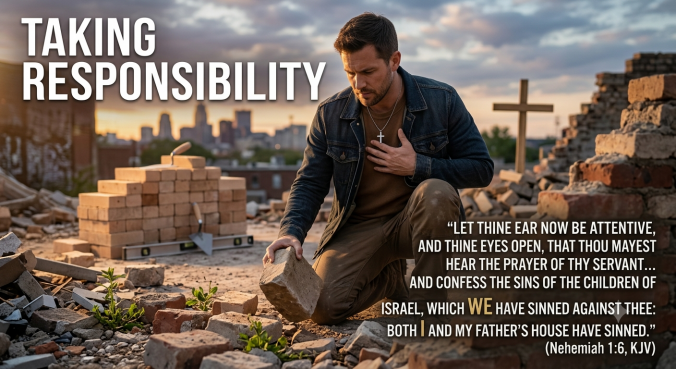
Taking Responsibility

“Let thine ear now be attentive, and thine eyes open, that thou mayest hear the prayer of thy servant, which I pray before thee now, day and night, for the children of Israel thy servants, and confess the sins of the children of Israel, which we have sinned against thee: both I and my father’s house have sinned.” (Nehemiah 1:6, KJV)

Whenever a crisis hits or a difficult situation unfolds, our natural human instinct is to look for someone else to blame. It is always much easier to point out the flaws, mistakes, and shortcomings of the people around us than it is to look honestly into our own hearts. When things begin to fall apart in our families, our churches, or our communities, we frequently look for a convenient scapegoat so we can remove our hands from the problem.

However, Nehemiah modeled a completely different approach to brokenness. When he received the devastating news about the ruined walls and burned gates of Jerusalem, he didn’t launch into a critical evaluation of the failed leaders who had preceded him. Instead, he fell to his knees in deep intercession. As he poured out his heart to the Lord, his prayer featured two incredibly powerful words: we and I. Rather than distancing himself from the problem, he included himself directly, taking personal blame for the brokenness of his homeland.

The Deception of Pointing Fingers

It would have been very easy for Nehemiah to point a finger at the generations of Israelites who had failed their responsibilities before him. After all, he was living hundreds of miles away, serving comfortably in the Persian palace. He had no personal role in the historic failures that led to Jerusalem’s destruction. Yet, he understood a vital truth that every believer must learn: pointing fingers simply does not get any work done. A great leader refuses to stand on the sidelines as a mere critic. Instead, a true leader must lead by example, being the first one to take responsibility and the first one to take up the tools to start building.

The Posture of True Prayer

God has graciously given us the privilege of prayer, allowing us to bring our deepest burdens directly before His throne. But prayer is not a platform for us to complain about the faults of others. We must enter into prayer with genuine humility and a repentant heart. If we approach God while harboring bitterness, or if we are constantly blaming others for our current situation, our prayers will be hindered. If we find ourselves focusing entirely on the failures of those around us, our first petition must be for God to change our own attitude.

Stepping into the Gap

Spiritual restoration can only begin when we stop making excuses and start owning our part in the circumstances around us. Nehemiah’s willingness to confess his own sins, along with the sins of his nation, cleared the way for God to use him in a miraculous way. When we humble ourselves and take responsibility, we invite the Holy Spirit to work through us to bring healing. Do not wait for someone else to take the first step toward reconciliation or rebuilding. Allow God to work on your heart today, and be willing to be the one who steps into the dust to start the restoration process.

Seed for Thought: Is there a broken area in your life, family, or church where you have been pointing fingers at others? Take a moment right now to bring that situation to the Lord in humility, asking Him to shift your focus from others’ failures to what He wants to do through you.

Reflect and Respond

  • Owning the Brokenness: When you pray about the problems in your immediate circle, do you include yourself in the confession, or do you view yourself as an innocent bystander? Reflect on how Nehemiah’s choice to use “we” and “I” opened the door for God’s power to move.
  • Leading by Example: Are you currently waiting for someone else to fix a broken situation, or are you willing to lead by example? Consider what it looks like to be the first one to take responsibility and actively pick up the tools to start building today.
  • Exchanging Blame for Humility: Think about whether you have been blaming others for your current circumstances. If so, are you willing to make your first petition a prayer for God to change your attitude? Commit to entering His presence with a truly humble and repentant heart.

Share this post

Empathy or Compassion?

“And it came to pass, when I heard these words, that I sat down and wept, and mourned certain days, and fasted, and prayed before the God of heaven,” (Nehemiah 1:4, KJV)

The mission project placed before Nehemiah was clearly obvious: he was called to rebuild the ruined city of Jerusalem. Yet, when we consider his life up to this point, the magnitude of this calling becomes even more striking. Nehemiah was part of the third generation of Hebrews living in captivity, meaning he was likely born in Persia and had never once set foot in the ancestral homeland of his forefathers.

Furthermore, the people currently living in Jerusalem were not his immediate relatives or near kinsmen. While it was entirely natural for him to feel a sense of empathy for these distant people in their affliction and reproach, human empathy alone would never provide the sustained passion required to successfully complete the monumental task God had set before him.

The Limitation of Human Empathy

True empathy is a basic human emotion that stems from a genuine love and caring for our fellow man. When we see a person in distress, a broken home, a fractured community, or a struggling church, our natural response is to feel their pain. However, empathy on its own has its limits. It allows us to feel sorrow for a situation, but it often lacks the enduring strength needed to bring about lasting restoration. For Nehemiah, a simple emotional reaction to the news of Jerusalem’s broken walls wasn’t enough; his natural empathy needed to be transformed into something far deeper.

The Catalyst of Divine Passion

Instead of letting his emotions fizzle out, Nehemiah allowed his empathy to drive him straight to his knees. He sat down and wept, mourned for days, fasted, and prayed as he passionately pleaded with God to find clear direction for rebuilding what had been broken. It was in this season of intercession that a powerful shift occurred: God replaced Nehemiah’s basic empathy with a divine passion. While empathy is a natural human emotion, true passion is instilled directly by our heavenly Father. It acts as a spiritual catalyst, energizing us to keep moving forward until the mission is fully complete.

Facing the Brokenness Around Us

As Christians, we will inevitably face many broken things throughout our journey in life. This brokenness may manifest deep within ourselves, or it may be evident in the lives of our nearby loved ones. At times, we will see it plaguing our local communities, or even affecting peoples and nations far across the globe. In every broken situation put before us, we cannot rely on superficial emotions. We must follow Nehemiah’s example and be willing to weep, fast, and pray for direction by the Holy Spirit.

When we surrender our natural feelings to the Lord, He promises to plant the very passion in our hearts that we need to accomplish His divine will.

Seed for Thought: What broken situation or hurting person has God placed in your path today? Take a moment right now to move past simple empathy, and ask the Lord to ignite a divine passion in your heart to fulfill your part in His plan for healing.

Reflect and Respond

  • Moving Beyond Empathy: When you encounter someone in distress or a broken situation, do you rely solely on natural empathy, or does that feeling drive you to your knees in prayer? Consider how Nehemiah’s initial sorrow served as a doorway to pleading with God for true direction.

  • The Fuel of Divine Passion: Reflect on the difference between a basic human emotion and a supernatural passion instilled by the Father. Are you currently trying to address a broken home, community, or church out of your own limited strength, or are you relying on the catalyst that energizes you to finish the task?
  • Seeking Holy Spirit Direction: Are you fully willing to weep, fast, and pray over the broken areas within yourself, your loved ones, or nations far away? Commit today to actively seeking the Holy Spirit’s guidance, trusting that God will plant the exact passion required to accomplish His divine will.

Share this post

Praying in Confidence

“And this is the confidence that we have in him, that, if we ask any thing according to his will, he heareth us: And if we know that he heareth us, whatsoever we ask, we know that we have the petitions that we desired of him.” (1 John 5:14-15, KJV)

There is a specific kind of weight that settles on the heart when we carry a burden for a loved one, a neighbor, or a colleague who has yet to experience the saving grace of Jesus Christ. We often find ourselves at a loss for words, wondering if our prayers are making a difference or if our Father even hears us.

However, the Apostle John provides us with a certainty for our prayer life. The word confidence used here means an assured boldness. He doesn’t suggest that we pray with a “hope so” attitude; he commands us to pray with a “know so” confidence.

The Method: Praying According to His Will

The first step in praying for the lost is aligning our petitions with the heart of the Father. When we pray for someone’s salvation, we aren’t guessing at God’s desires. We know that the Lord is “not willing that any should perish, but that all should come to repentance” (2 Peter 3:9).

When you name that specific person in your quiet time, you are standing on the bedrock of God’s revealed will. The method is simple but significant: take the name of the lost and bind it to the promise of the Word. Paul expressed this same method in Romans 10:1: “Brethren, my heart’s desire and prayer to God for Israel is, that they might be saved.” Your specific desire for their soul is a reflection of God’s own heart.

The Attitude: The Quietness of Certainty

The scripture tells us that if we ask according to His will, “he heareth us.” This isn’t just about auditory perception; it’s about divine attention. The moment the name of that lost soul leaves your lips in faith, the ear of the Almighty is inclined toward you.

John goes a step further: “And if we know that he heareth us… we know that we have the petitions that we desired of him.” This is the attitude of the expectant intercessor. We do not need to wait for the outward signs of change to believe that God is at work. We can rest in the “knowing” that the petition has been granted in the spiritual realm.

Sowing the Seed of Prayer

Do not let “spiritual drift” or discouragement silence your intercession. If you have been praying for a child, a spouse, or a friend for years, remember that the “confidence” mentioned in 1 John is not based on the speed of the result, but on the character of the Hearer.

Continue to ask. Continue to seek. Stand in the gap with the assurance that your prayers are not in vain, for He who promised is faithful.

Seed for Thought: Who is the one person God has laid on your heart today? Take a moment right now to present their name before the throne, knowing that you are asking exactly what He desires to give.

Reflect and Respond

  • Aligning the Will: When you intercede for the lost, do you approach God with a “hope so” attitude, or do you stand on the certainty that it is His revealed will for all to come to repentance? Consider how 2 Peter 3:9 provides a “bedrock” of confidence for your specific request.

  • The Hearing of God: Does the knowledge that God grants “divine attention” to your prayers change the way you handle periods of silence? Reflect on the “quietness of certainty” that comes from knowing He hears you the moment a name leaves your lips in faith.
  • Persistent Sowing: Are you currently binding the names of your loved ones to the promises of the Word, or have you allowed “spiritual drift” to discourage your intercession? Remember that your confidence is anchored in the character of the Hearer rather than the speed of the result.

Share this post

Keep On Praying

“Ask, and it shall be given you; seek, and ye shall find; knock, and it shall be opened unto you:” (Matthew 7:7)

Ask. A simple three letter word that sets things in motion. It’s how we get the things we want. We ask the waitress to bring our food selection from the menu. We ask our coworker to help us lift a heavy object and move it where it needs to be. We ask the pretty girl to go out on a date. Without the ask, we can be assured none of those things we want will happen. We go hungry because the waitress never brings us food. We get reprimanded when we don’t get the job done at work. We never get the opportunity to kiss the girl.

Jesus teaches us in our verse today that it works the same way with our heavenly Father. We must ask for the things we want. God’s storehouse is overflowing with gifts for His children. But He waits for us to come to Him in prayer and ask for the desires of our heart. Yes, sometimes He will drop a surprise in our lap, just like our earthly fathers sometimes give us gifts we aren’t expecting. And while our Father knows all that we have need of, He desires the intimacy of a conversation with us. He wants us to come to Him and ask.

Seek. Many times though, especially early in our Christian growth, our Father will say no when ask him for something. God always knows what’s best for us. He sees the future that we can’t. The answer of no then prompts the question, “why not?”. Our ask must always be according to God’s will. That’s why Jesus tells us to seek. We must search God’s word, meditate on it in prayer, and eventually the Holy Spirit will reveal the answer to us. Seeking is how we develop deeper conversations with our Father. In that deeper connection we begin to understand God’s character and will for our life. It’s there we learn what to ask for that will be pleasing to our Father. We must continuously seek God’s will.

Knock. God rewards our seeking with wisdom which gives us understanding, confidence, and assurance. With that in hand we must be persistent. Maintaining enthusiasm while working on any project is key to successfully accomplishing the task set before us. Keep knocking until the ask is answered. Not only does our persistence show our Father that we trust Him, but it also motivates the faith of those watching us in our day to day Christian walk.

Keep on asking. Keep on seeking. Keep on knocking. Keep on PRAYING!!


Share this post

Prayer of Surrender

And he said unto me, My grace is sufficient for thee: for my strength is made perfect in weakness. Most gladly therefore will I rather glory in my infirmities, that the power of Christ may rest upon me. (2 Corinthians 12:9)

LORD Jesus,

In this chaos that is my life, I only find peace in Your salvation. My feet are firmly planted on You, my Rock, held not by my trembling bones, but firmly by Your strong arm. By Your Word, I walk steadfastly, for it provides the direction for my path. Your Word is everlasting and true. Your mercy is sweet as honey to my wretched soul. In Your grace I find my purpose in working to build Your kingdom. Though my flesh is weak and faltering, my soul rests beneath Your protective wings. LORD, I pray, use my hands, my feet, my tongue, my being, to lift up and glorify Your name. Whatever situation or circumstance I find myself, I pray You shine Your light through me. I surrender my life to You again today. Use it according to Your divine will.

In Your name, for Your glory, Amen.

Share this post

Wait Upon the LORD

“But they that wait upon the LORD shall renew their strength; they shall mount up with wings as eagles; they shall run, and not be weary; and they shall walk, and not faint.” (Isaiah 40:31)

The phrase “wait upon” means to eagerly look for or linger in expectation. Waiting on the Lord renews our strength by compelling us to rely on God’s power. In the haste of life, we can often neglect time with God. We fill our schedules, rushing from one task to the next, yet we wonder why we feel drained, weary, and disconnected from God.

What we need is to slow down, wait on the Lord, and spend time with Him in prayer. When we wait on God, we open our hearts to receive His strength and peace. As we meditate on His Word, we are refreshed and renewed. Our minds are no longer cluttered with the cares of this world. We experience the presence of God as we surrender our agendas to Him.

Waiting on God through prayer deepens our relationship with Him. It realigns our priorities to what matters most – connecting with our Creator. When we regularly devote time to seek God’s face, we are transformed and our spiritual strength is renewed.

Let’s determine to build our prayer life through daily quiet times with God. Whether it’s 20 minutes in the morning, an hour walk with Him in the evening, or breath prayers throughout the day, time with God nourishes our soul. As we wait on Him, God renews us to walk faithfully with Him.

Lord, we desire to know You more. Teach us to regularly wait on You, to be still before You in prayer. Renew our strength as we seek Your face. Help us prioritize time with You, for apart from You we can do nothing. Fill us with Your Spirit. In Jesus’ name, Amen.

Share this post

Thank You Jesus

“I will give thanks to the Lord with my whole heart; I will recount all of your wonderful deeds.” (Psalm 9:1)

In our journey of faith, we often find ourselves seeking miracles, looking for grand signs that will affirm our beliefs. But sometimes, it’s the smallest, everyday moments that hold the power to kindle profound joy in our hearts.

My friends, our path to gratitude and joy begins with mindful appreciation of the daily blessings that surround us. It’s easy to overlook these gifts, but they are like precious gems waiting to be discovered. It might be the warmth of the morning sun, the laughter of a loved one, or the simple taste of a well-cooked meal. Each of these is a marvelous work of the Creator.

As we start our gratitude practice, let us remember that it’s not about the grand gestures but the little things that light up our hearts. Try this: today, pause for a moment, take a deep breath, and think of three things you’re grateful for. They can be as humble as a gentle breeze or a cozy blanket. When we express our gratitude with our whole hearts, we begin to uncover the joy hidden in these small, everyday wonders.

Remember, my dear friends, that as we foster gratitude, we not only find joy in the little things but also draw closer to our Heavenly Father, who delights in our praises and showers us with His boundless love.

In this journey, we invite God to help us in fostering our gratitude and finding joy. Let us pray together:

Heavenly Father, we come before you with open hearts, seeking the joy in the little things that you’ve surrounded us with. We thank you for the daily blessings that may often go unnoticed. Help us, O Lord, to develop a mindfulness that appreciates your marvelous works in every moment. May our gratitude practice be a testament to your love and grace. In Jesus’ name we pray. Amen.

Share this post

Secret Prayers

But thou, when thou prayest, enter into thy closet, and when thou hast shut thy door, pray to thy Father which is in secret; and thy Father which seeth in secret shall reward thee openly. (Matthew 6:6)

Let’s take time today to go to our inner room, close the door, and pray to our Father in secret. In the busyness of life, it’s easy to push our prayer life to the margins. But prayer is vital for deepening our connection to God. When we pray, we enter into intimate communion with our Creator.

Prayer is not simply reciting requests or repeating memorized words. True prayer engages our mind, heart, and spirit. It’s an act of fully focusing on God – acknowledging His presence within and around us. We quiet our thoughts, let go of distractions, and open our inner being to receive His peace, wisdom, and guidance.

As we pray, we can share our honest thoughts and feelings with God. We can cry out in despair, grieve our losses, confess our shortcomings. Or we can voice gratitude, ask for help or insight, and praise Him for His goodness. God already knows our hearts, yet He invites us to freely express ourselves. Through prayer, we cast our cares upon the Lord, knowing He hears us and responds in His perfect way and timing.

Prayer also requires listening. When we still our mind and spirit, we make room to hear God’s gentle voice. His words may come as scripture that suddenly surfaces in our memory, an impression that guides our thoughts, or simply a sense of His presence reassuring us. Regular prayer helps us recognize God’s voice and discern His direction for our life.

Father, we desire to deepen our relationship with You. Help us regularly practice heartfelt prayer. Quiet our distracted thoughts, so we can focus completely on Your loving presence. Speak to us, Lord. Reveal areas where we need to surrender and grow. Fill us with Your peace and wisdom, so we can walk in step with Your Spirit each day. In Jesus’ name, Amen.

Share this post
« Older posts

© 2026 SeedSowing.org

Theme by Anders Noren — Up ↑