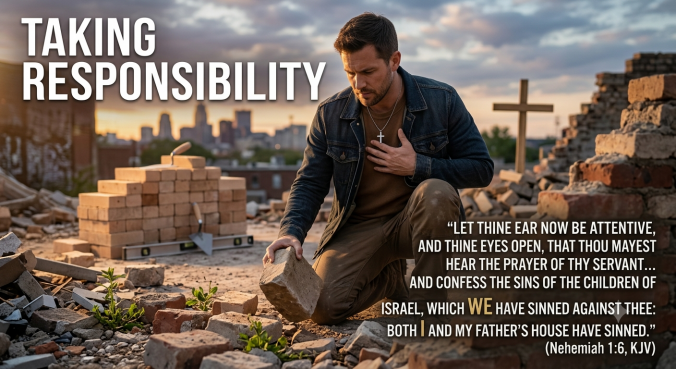
“Let thine ear now be attentive, and thine eyes open, that thou mayest hear the prayer of thy servant, which I pray before thee now, day and night, for the children of Israel thy servants, and confess the sins of the children of Israel, which we have sinned against thee: both I and my father’s house have sinned.” (Nehemiah 1:6, KJV)
Whenever a crisis hits or a difficult situation unfolds, our natural human instinct is to look for someone else to blame. It is always much easier to point out the flaws, mistakes, and shortcomings of the people around us than it is to look honestly into our own hearts. When things begin to fall apart in our families, our churches, or our communities, we frequently look for a convenient scapegoat so we can remove our hands from the problem.
However, Nehemiah modeled a completely different approach to brokenness. When he received the devastating news about the ruined walls and burned gates of Jerusalem, he didn’t launch into a critical evaluation of the failed leaders who had preceded him. Instead, he fell to his knees in deep intercession. As he poured out his heart to the Lord, his prayer featured two incredibly powerful words: we and I. Rather than distancing himself from the problem, he included himself directly, taking personal blame for the brokenness of his homeland.
The Deception of Pointing Fingers
It would have been very easy for Nehemiah to point a finger at the generations of Israelites who had failed their responsibilities before him. After all, he was living hundreds of miles away, serving comfortably in the Persian palace. He had no personal role in the historic failures that led to Jerusalem’s destruction. Yet, he understood a vital truth that every believer must learn: pointing fingers simply does not get any work done. A great leader refuses to stand on the sidelines as a mere critic. Instead, a true leader must lead by example, being the first one to take responsibility and the first one to take up the tools to start building.
The Posture of True Prayer
God has graciously given us the privilege of prayer, allowing us to bring our deepest burdens directly before His throne. But prayer is not a platform for us to complain about the faults of others. We must enter into prayer with genuine humility and a repentant heart. If we approach God while harboring bitterness, or if we are constantly blaming others for our current situation, our prayers will be hindered. If we find ourselves focusing entirely on the failures of those around us, our first petition must be for God to change our own attitude.
Stepping into the Gap
Spiritual restoration can only begin when we stop making excuses and start owning our part in the circumstances around us. Nehemiah’s willingness to confess his own sins, along with the sins of his nation, cleared the way for God to use him in a miraculous way. When we humble ourselves and take responsibility, we invite the Holy Spirit to work through us to bring healing. Do not wait for someone else to take the first step toward reconciliation or rebuilding. Allow God to work on your heart today, and be willing to be the one who steps into the dust to start the restoration process.
Seed for Thought: Is there a broken area in your life, family, or church where you have been pointing fingers at others? Take a moment right now to bring that situation to the Lord in humility, asking Him to shift your focus from others’ failures to what He wants to do through you.
Reflect and Respond
- Owning the Brokenness: When you pray about the problems in your immediate circle, do you include yourself in the confession, or do you view yourself as an innocent bystander? Reflect on how Nehemiah’s choice to use “we” and “I” opened the door for God’s power to move.
- Leading by Example: Are you currently waiting for someone else to fix a broken situation, or are you willing to lead by example? Consider what it looks like to be the first one to take responsibility and actively pick up the tools to start building today.
-
Exchanging Blame for Humility: Think about whether you have been blaming others for your current circumstances. If so, are you willing to make your first petition a prayer for God to change your attitude? Commit to entering His presence with a truly humble and repentant heart.

Leave a Reply