"Who hath ears to hear, let him hear."

Category: Inspirational (Page 1 of 2)

From Reproach to Restoration

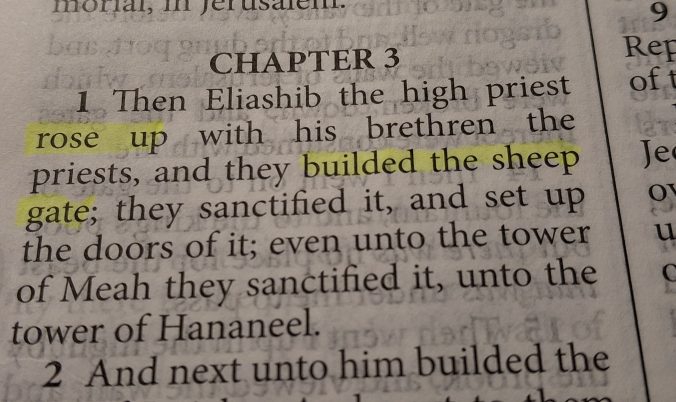
“Then said I unto them, Ye see the distress that we are in, how Jerusalem lieth waste, and the gates thereof are burned with fire: come, and let us build up the wall of Jerusalem, that we be no more a reproach.” (Nehemiah 2:17, KJV)

Our Heavenly Father has called us to live our lives as shining examples to the dark world around us. In every area we are associated with; whether in business, at church, within our personal relationships, or inside our marriages, our lives ought to clearly reflect the love and grace of Jesus Christ. Anything less portrays a life in spiritual distress.

Nehemiah didn’t downplay the situation when he spoke to the leaders of Jerusalem. He pointed directly to the blackened gates and the heaps of rubble and said, “Ye see the distress that we are in”. He didn’t try to pretend everything was fine, nor did he make light of the ruin. He called out the heartbreak for what it was so they could finally move toward restoration.

The Meaning of Distress

To really grasp what was happening in Jerusalem, it helps to look at the word Nehemiah used for “distress”. It is translated from the original Hebrew root word rah, meaning something bad, evil, spoiled, or afflicted. It derives from raw-ah’, describing a bitter affliction or punishment that comes as a direct consequence of moral corruptness.

Jerusalem’s terrible condition wasn’t just bad luck or a sudden turn of political fortune. Israel’s persistent disobedience to God had brought the city into this miserable state of distress. That distress produced “reproach”, a word that means open shame and disgrace. When the surrounding pagan nations looked at the broken walls of God’s holy city, they mocked the God of Israel. Jerusalem’s public shame was a direct dishonor to God.

The Burden of an Ineffective Witness

The same principle applies to our personal lives today. We dishonor God when we allow our lives to fall into a state of distress due to ongoing disobedience or spiritual compromise. The reality is simple: we cannot be an effective witness for Christ when our own life is in shambles.

If our marriages are distressed by selfish conflict, if our business dealings lack honesty, or if our personal conduct looks no different than the surrounding culture, the world notices. Instead of drawing people to the beauty of the gospel, our spiritual distress becomes a reproach that turns others away.

Turning to the Great Restorer

Thankfully, the story doesn’t end in ruin. God worked powerfully through Nehemiah to restore the physical brokenness of Jerusalem. In an even greater way, God works through His Son, Jesus Christ, to restore our broken relationship with Him.

He doesn’t ask us to fix ourselves before coming to Him. He simply asks that we turn to Him in genuine humility and true repentance. When we stop making excuses for our disobedience and confess our distress, Christ steps in to forgive us, lift our reproach, and rebuild our lives from the ground up.

Seed for Thought: Is there an area of your life; your marriage, your career, or your private habits, that currently reflects distress rather than the love of Christ? Take a moment right now to bring that brokenness to Jesus in humility, asking Him to begin His work of spiritual restoration.

Reflect and Respond

Evaluating Your Witness: Does your daily conduct in business, relationships, and family life serve as a clear reflection of Jesus’ love; or does it portray a life in distress? Consider how your personal choices affect the way others view your faith.

Understanding the Root of Distress: Nehemiah recognized that Jerusalem’s brokenness was the bitter fruit of disobedience. Are you harboring any unconfessed sin or compromise that is causing spiritual damage in your walk with Christ?

Turning to the Restorer: Remember that just as God used Nehemiah to rebuild Jerusalem, Jesus stands ready to restore your broken relationship with Him. Are you willing to come before Him today in sincere repentance and humility to let Him rebuild what has been damaged?

Share this post

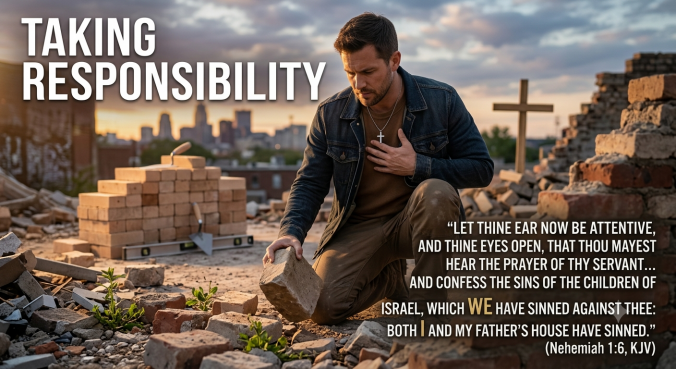
Taking Responsibility

Let thine ear now be attentive, and thine eyes open, that thou mayest hear the prayer of thy servant, which I pray before thee now, day and night, for the children of Israel thy servants, and confess the sins of the children of Israel, which we have sinned against thee: both I and my father’s house have sinned.” (Nehemiah 1:6, KJV)

Whenever a crisis hits or a difficult situation unfolds, our natural human instinct is to look for someone else to blame. It is always much easier to point out the flaws, mistakes, and shortcomings of the people around us than it is to look honestly into our own hearts. When things begin to fall apart in our families, our churches, or our communities, we frequently look for a convenient scapegoat so we can remove our hands from the problem.

However, Nehemiah modeled a completely different approach to brokenness. When he received the devastating news about the ruined walls and burned gates of Jerusalem, he didn’t launch into a critical evaluation of the failed leaders who had preceded him. Instead, he fell to his knees in deep intercession. As he poured out his heart to the Lord, his prayer featured two incredibly powerful words: we and I. Rather than distancing himself from the problem, he included himself directly, taking personal blame for the brokenness of his homeland.

The Deception of Pointing Fingers

It would have been very easy for Nehemiah to point a finger at the generations of Israelites who had failed their responsibilities before him. After all, he was living hundreds of miles away, serving comfortably in the Persian palace. He had no personal role in the historic failures that led to Jerusalem’s destruction. Yet, he understood a vital truth that every believer must learn: pointing fingers simply does not get any work done. A great leader refuses to stand on the sidelines as a mere critic. Instead, a true leader must lead by example, being the first one to take responsibility and the first one to take up the tools to start building.

The Posture of True Prayer

God has graciously given us the privilege of prayer, allowing us to bring our deepest burdens directly before His throne. But prayer is not a platform for us to complain about the faults of others. We must enter into prayer with genuine humility and a repentant heart. If we approach God while harboring bitterness, or if we are constantly blaming others for our current situation, our prayers will be hindered. If we find ourselves focusing entirely on the failures of those around us, our first petition must be for God to change our own attitude.

Stepping into the Gap

Spiritual restoration can only begin when we stop making excuses and start owning our part in the circumstances around us. Nehemiah’s willingness to confess his own sins, along with the sins of his nation, cleared the way for God to use him in a miraculous way. When we humble ourselves and take responsibility, we invite the Holy Spirit to work through us to bring healing. Do not wait for someone else to take the first step toward reconciliation or rebuilding. Allow God to work on your heart today, and be willing to be the one who steps into the dust to start the restoration process.

Seed for Thought: Is there a broken area in your life, family, or church where you have been pointing fingers at others? Take a moment right now to bring that situation to the Lord in humility, asking Him to shift your focus from others’ failures to what He wants to do through you.

Reflect and Respond

  • Owning the Brokenness: When you pray about the problems in your immediate circle, do you include yourself in the confession, or do you view yourself as an innocent bystander? Reflect on how Nehemiah’s choice to use “we” and “I” opened the door for God’s power to move.
  • Leading by Example: Are you currently waiting for someone else to fix a broken situation, or are you willing to lead by example? Consider what it looks like to be the first one to take responsibility and actively pick up the tools to start building today.
  • Exchanging Blame for Humility: Think about whether you have been blaming others for your current circumstances. If so, are you willing to make your first petition a prayer for God to change your attitude? Commit to entering His presence with a truly humble and repentant heart.

Share this post

Empathy or Compassion?

And it came to pass, when I heard these words, that I sat down and wept, and mourned certain days, and fasted, and prayed before the God of heaven,” (Nehemiah 1:4, KJV)

The mission project placed before Nehemiah was clearly obvious: he was called to rebuild the ruined city of Jerusalem. Yet, when we consider his life up to this point, the magnitude of this calling becomes even more striking. Nehemiah was part of the third generation of Hebrews living in captivity, meaning he was likely born in Persia and had never once set foot in the ancestral homeland of his forefathers.

Furthermore, the people currently living in Jerusalem were not his immediate relatives or near kinsmen. While it was entirely natural for him to feel a sense of empathy for these distant people in their affliction and reproach, human empathy alone would never provide the sustained passion required to successfully complete the monumental task God had set before him.

The Limitation of Human Empathy

True empathy is a basic human emotion that stems from a genuine love and caring for our fellow man. When we see a person in distress, a broken home, a fractured community, or a struggling church, our natural response is to feel their pain. However, empathy on its own has its limits. It allows us to feel sorrow for a situation, but it often lacks the enduring strength needed to bring about lasting restoration. For Nehemiah, a simple emotional reaction to the news of Jerusalem’s broken walls wasn’t enough; his natural empathy needed to be transformed into something far deeper.

The Catalyst of Divine Passion

Instead of letting his emotions fizzle out, Nehemiah allowed his empathy to drive him straight to his knees. He sat down and wept, mourned for days, fasted, and prayed as he passionately pleaded with God to find clear direction for rebuilding what had been broken. It was in this season of intercession that a powerful shift occurred: God replaced Nehemiah’s basic empathy with a divine passion. While empathy is a natural human emotion, true passion is instilled directly by our heavenly Father. It acts as a spiritual catalyst, energizing us to keep moving forward until the mission is fully complete.

Facing the Brokenness Around Us

As Christians, we will inevitably face many broken things throughout our journey in life. This brokenness may manifest deep within ourselves, or it may be evident in the lives of our nearby loved ones. At times, we will see it plaguing our local communities, or even affecting peoples and nations far across the globe. In every broken situation put before us, we cannot rely on superficial emotions. We must follow Nehemiah’s example and be willing to weep, fast, and pray for direction by the Holy Spirit.

When we surrender our natural feelings to the Lord, He promises to plant the very passion in our hearts that we need to accomplish His divine will.

Seed for Thought: What broken situation or hurting person has God placed in your path today? Take a moment right now to move past simple empathy, and ask the Lord to ignite a divine passion in your heart to fulfill your part in His plan for healing.

Reflect and Respond

  • Moving Beyond Empathy: When you encounter someone in distress or a broken situation, do you rely solely on natural empathy, or does that feeling drive you to your knees in prayer? Consider how Nehemiah’s initial sorrow served as a doorway to pleading with God for true direction.

  • The Fuel of Divine Passion: Reflect on the difference between a basic human emotion and a supernatural passion instilled by the Father. Are you currently trying to address a broken home, community, or church out of your own limited strength, or are you relying on the catalyst that energizes you to finish the task?
  • Seeking Holy Spirit Direction: Are you fully willing to weep, fast, and pray over the broken areas within yourself, your loved ones, or nations far away? Commit today to actively seeking the Holy Spirit’s guidance, trusting that God will plant the exact passion required to accomplish His divine will.

Share this post

Prayer of Surrender

And he said unto me, My grace is sufficient for thee: for my strength is made perfect in weakness. Most gladly therefore will I rather glory in my infirmities, that the power of Christ may rest upon me. (2 Corinthians 12:9)

LORD Jesus,

In this chaos that is my life, I only find peace in Your salvation. My feet are firmly planted on You, my Rock, held not by my trembling bones, but firmly by Your strong arm. By Your Word, I walk steadfastly, for it provides the direction for my path. Your Word is everlasting and true. Your mercy is sweet as honey to my wretched soul. In Your grace I find my purpose in working to build Your kingdom. Though my flesh is weak and faltering, my soul rests beneath Your protective wings. LORD, I pray, use my hands, my feet, my tongue, my being, to lift up and glorify Your name. Whatever situation or circumstance I find myself, I pray You shine Your light through me. I surrender my life to You again today. Use it according to Your divine will.

In Your name, for Your glory, Amen.

Share this post

Thank You Jesus

“I will give thanks to the Lord with my whole heart; I will recount all of your wonderful deeds.” (Psalm 9:1)

In our journey of faith, we often find ourselves seeking miracles, looking for grand signs that will affirm our beliefs. But sometimes, it’s the smallest, everyday moments that hold the power to kindle profound joy in our hearts.

My friends, our path to gratitude and joy begins with mindful appreciation of the daily blessings that surround us. It’s easy to overlook these gifts, but they are like precious gems waiting to be discovered. It might be the warmth of the morning sun, the laughter of a loved one, or the simple taste of a well-cooked meal. Each of these is a marvelous work of the Creator.

As we start our gratitude practice, let us remember that it’s not about the grand gestures but the little things that light up our hearts. Try this: today, pause for a moment, take a deep breath, and think of three things you’re grateful for. They can be as humble as a gentle breeze or a cozy blanket. When we express our gratitude with our whole hearts, we begin to uncover the joy hidden in these small, everyday wonders.

Remember, my dear friends, that as we foster gratitude, we not only find joy in the little things but also draw closer to our Heavenly Father, who delights in our praises and showers us with His boundless love.

In this journey, we invite God to help us in fostering our gratitude and finding joy. Let us pray together:

Heavenly Father, we come before you with open hearts, seeking the joy in the little things that you’ve surrounded us with. We thank you for the daily blessings that may often go unnoticed. Help us, O Lord, to develop a mindfulness that appreciates your marvelous works in every moment. May our gratitude practice be a testament to your love and grace. In Jesus’ name we pray. Amen.

Share this post

Be Still

“Be still, and know that I am God: I will be exalted among the heathen, I will be exalted in the earth.” Psalm 46:10 (KJV)

When external forces suddenly shift the ground under our feet, stillness sounds dangerously counterintuitive. As life unravels unexpectedly, instinct demands grabbing control rather than releasing outcomes to God’s care. We rely on restless striving, vainly attempting to steady the crumbling landscape surrounding us instead of trusting the Solid Rock who upholds all things through raging storms.

Yet God commands His children oppositely in tumultuous times: Be still. Cease striving. Surrender thwarted plans and don’t demand answers or solutions on your timeline. For stillness stabilizes perspective. Stillness imparts opportunity to behold the Almighty One reigning unthreatened over human frailties and furies. Our still reflection should mirror back the unshakable God dwarfing disruption and chaos rampant on earth.

The faithful behold the Ancient of Days steady despite the undulations of passing ages and fashions. “For I am the LORD, I change not; therefore ye sons of Jacob are not consumed.” (Malachi 3:6) Shall we not also know with utmost certainty that though old orders may pass away abruptly; His love withstands resiliently upholding His beloved?

What raging storms tempt reactionary responses today? Pause and ponder instead God’s track record proving almighty faithfulness through history’s stormy eons. Fix your eyes on His immutable character. He alone calms the billows with a word. No foaming tide overflows the boundaries He establishes. Be still in this eternal assurance: The Lord God Most High transcends every threat. He shall receive glory displaying timeless salvation.

Lord, we admit our propensity to plaster over erupting instability with busy striving. Teach us the power unleashed through stillness anchored securely in who You are, not what swirls around us. May we behold You today—unthreatened Majesty calming storms with one whisper, who “laughs at the tempest and rides upon the storm.” In Jesus’ name we pray, Amen.

Share this post

Choose to be Grateful


Let there be no filthiness nor foolish talk nor crude joking, which are out of place, but instead let there be thanksgiving.
(Ephesians 5:4 ESV)

In a world filled with challenges and uncertainties, it’s easy to lose sight of the things that bring us hope and happiness. But amidst it all, we have a powerful choice – the choice to be grateful.

How you feel – how happy you are, how stressed you are, even how well you sleep – may seem like it’s out of your hands, but it is actually a choice you make. You can choose to be grateful for what you have and allow God to bring joy in your heart. Or you can choose to focus on what you’re lacking, who has wronged you, and what’s not going your way. And guess what? You’ll feel miserable. You may blame others, circumstances, or fate for your unhappiness. But at the end of the day, it’s all about the choices you make. You choose happiness or misery.

Gratitude is not just a fleeting emotion that comes and goes; it is a powerful mindset and a way of life. It goes beyond simply saying “thank you” – it is about cultivating an attitude of appreciation and acknowledging the abundant blessings, big or small, that God provides each and every day. When we choose to embrace gratitude, we are able to shift our perspective from focusing on what may be lacking in our lives to recognizing the incredible abundance that is already present. Paul wrote in Philippians 4:11-13 KJV, Not that I speak in respect of want: for I have learned, in whatsoever state I am, therewith to be content. (12) I know both how to be abased, and I know how to abound: every where and in all things I am instructed both to be full and to be hungry, both to abound and to suffer need. (13) I can do all things through Christ which strengtheneth me. Gratitude allows us to find joy in the ordinary moments, to see beauty in the simplest of things, and to truly appreciate all that life has to offer. So let us take a moment each day to pause, reflect, and thank God for the myriad of blessings that enrich our lives.

Embracing a mindset of gratitude doesn’t require us to turn a blind eye to the challenges and hardships we encounter on our journey. Rather, it empowers us to find strength and resilience through Christ in the face of adversity. It is through these struggles that we grow and learn valuable lessons that shape our character. Expressing gratitude allows us to discover moments of joy even in the simplest things. It is about pausing, taking a deep breath, and appreciating the beauty that surrounds us every day. Whether it’s the warmth of sunlight on our skin or the laughter shared with loved ones, gratitude opens our hearts to the abundance of blessings in our lives. Let us strive to be thankful not only during moments of triumph but also during times of difficulty. By cultivating an attitude of gratitude, we can transform challenges into opportunities for growth and find solace in knowing that every experience contributes to our personal development. Within every struggle lies an opportunity for growth, and within every difficulty lies a chance for resilience. James 1:2-3 ESV Count it all joy, my brothers, when you meet trials of various kinds, (3) for you know that the testing of your faith produces steadfastness. Embrace gratitude as your guiding light, allowing it to illuminate your path and infuse each day with a greater appreciation of God’s work in your life.

When we consciously choose to embrace gratitude in our lives, we are inviting an abundance of positivity and joy to flow into every facet of our existence. Gratitude is not just a mere expression of thanks; it is a powerful mindset that can transform the way we perceive the world. By practicing gratitude, we open doors to new opportunities that may have otherwise been overlooked. It allows us to recognize the blessings and gifts that surround us, even in times of challenge or difficulty. As we cultivate a grateful heart, our outlook becomes brighter, and we become more receptive to the endless possibilities that await us.

Gratitude has a profound impact on our relationships with others. When we express appreciation and acknowledge the goodness in those around us, we strengthen the bonds that connect us. The act of showing gratitude creates an atmosphere of love and understanding, deepening our connections with family, friends, colleagues, and even strangers. Beyond personal benefits, gratitude has a ripple effect on society as a whole. When one person chooses to be grateful, it spreads like wildfire touching the lives of those they encounter. Gratefulness becomes contagious as it ignites kindness and compassion within others. By simply expressing gratitude, we have the power to uplift spirits and make a positive difference in someone’s day. So let us remember that when faced with life’s challenges or mundane routines, choosing gratitude allows God to transform our lives for the better. Embrace this beautiful practice and watch as it brings forth abundance, strengthens relationships, and radiates kindness throughout your journey.

Share this post

The Blind May See

John 9:5-7 KJV “As long as I am in the world, I am the light of the world.
(6) When he had thus spoken, he spat on the ground, and made clay of the spittle, and he anointed the eyes of the blind man with the clay,
(7) And said unto him, Go, wash in the pool of Siloam, (which is by interpretation, Sent.) He went his way therefore, and washed, and came seeing.”

What a powerful passage from the Bible! In John 9:5-7, we witness Jesus proclaiming himself as the light of the world. His words are filled with hope and assurance. It is truly inspiring to see how he then takes action to demonstrate his power by healing a blind man. Jesus’ compassion knows no bounds as he uses humble elements like clay and spittle to bring about this miraculous healing. The simple act of anointing the blind man’s eyes with clay ignites faith and creates a path for transformation. Moreover, Jesus instructs the blind man to go and wash in the pool of Siloam. This act signifies not only physical cleansing but also spiritual renewal. Many times in scripture we know that water signifies the Word of God. There can be no transformation without the Word of God.

By obeying Jesus’ command without hesitation, the blind man experiences an incredible miracle—he goes from darkness into sight. This story is a beautiful reminder that even in our darkest moments, there is always hope for restoration and transformation. Just as Jesus was the light of that world then, he continues to be our guiding light today. Let us trust in his power and have faith that he can bring about miracles in our lives too.

In the journey of discipleship, we often find ourselves spiritually blind, unable to see the path ahead. However, just as Jesus brought physical sight to the blind, He also offers us a spiritual awakening that can illuminate our lives.

The story of the blind man in the Bible serves as a powerful reminder that no matter how lost we may feel, there is always hope for transformation. Jesus not only healed the physical blindness of this man but also opened his eyes to a deeper understanding of faith and truth.

Just as Jesus used His divine power to restore sight to the blind man, He can also bring light into our lives and help us see things from a new perspective. Through prayer, reflection, and seeking His guidance, we can experience a profound revelation that leads us towards growth and fulfillment.

Let us remember that even in our darkest moments, there is an opportunity for spiritual growth. Like the blind man who encountered Jesus, we too can be transformed by His love and grace. Embrace this journey with faith and trust in Him, for through Him, even the blind may see.

Take inspiration from this passage and remember that you are not alone on your journey. With faith, obedience, and perseverance, you too can experience extraordinary breakthroughs just like the blind man did when he washed in Siloam’s pool. Keep shining your light brightly!


Share this post

The Obvious Question

And a certain man was there, which had an infirmity thirty and eight years. When Jesus saw him lie, and knew that he had been now a long time in that case, he saith unto him, Wilt thou be made whole? (John 5:5-6)

“Wilt thou be made whole?” Why would Jesus ask such a question? Of course, this man wanted healing! He had an infirmity for 38 years. Now we don’t know how old this man was, or how long he had laid by this pool, watching for a ripple of water. But we know his attention was on the water. Jesus’ question was intended to draw this man’s eyes off the superstitious water and put them on Himself. This impotent man needed to turn his eyes to the omnipotent God.

I read somewhere while studying for this post, that Jesus asked a question 307 times in the New Testament, but only gave an answer to His questions three times. God’s word should cause us to question ourselves, so that we can see our weaknesses, our lack of wisdom, our inability to measure up to God’s standard. This impotent man would never see his true condition by staring at a pool. There are many people in the same condition today, waiting, watching, yearning for some feeling, some emotion, something physical that will change their life. People are hungry for something to make their life different, perhaps not knowing what change they want, just something different; hanging their hopes on “good vibes” or maybe karma will look kindly on them. We need to follow Christ’s example here. We need to ask the lost and dying people the obvious questions to take their eyes off the false hopes the world has to offer. Wilt thou be made whole? There is no healing in the pool, but there is eternal life in Jesus Christ.

Share this post

A Determined Choice

“Woe is me!” The prophet Micah laments his circumstances in the seventh chapter of his discourse to the leaders of Israel, speaking of the wickedness surrounding him. We can sympathize with Micah’s plight today. Our leaders seem to have no regard for the people. In chapter 2, Micah describes those in power as devising evil at night to practice when the morning light comes. Their greed drove them to oppress the common people without any sign of remorse. Judges required bribes for their verdicts. The rich and powerful would entangle their mischief in the courts allowing them to continue their evil ways. Sound familiar?

Micah was given the unpopular task of proclaiming God’s impending judgement on Israel. His bold witness for God was believed by a few and rejected by many. In chapter 7 Micah speaks of discord within close family members. The controversies caused by his witness surely affected his mental state. We can easily be discouraged at the mockery of God we see around us.

But Micah made a determined choice to trust God. In verses 7-8 we read; “Therefore I will look unto the LORD; I will wait for the God of my salvation: my God will hear me. Rejoice not against me, O mine enemy: when I fall, I shall arise; when I sit in darkness, the LORD shall be a light unto me.” (Micah 7:7-8)

We can easily get distressed if we watch all the evil going on around us. It may seem like the whole world is against us. But like Micah, we must determine to look unto the LORD, trust Him, and allow Him to be our light in this dark world. God gives rest to the weary, strength to the down-trodden, and comfort to the brokenhearted.

Share this post
« Older posts

© 2026 SeedSowing.org

Theme by Anders NorenUp ↑